


How can we help?
Description

选择另一个国家或地区,以获得适用于你所在位置的内容和在线购物选项。
了解更多 →

Give customers details about the banner image(s) or content on the template.

Give customers details about the banner image(s) or content on the template.

Give customers details about the banner image(s) or content on the template.

Give customers details about the banner image(s) or content on the template.
Pair text with an image to focus on your chosen product, collection, or blog post. Add details on availability, style, or even provide a review.

Lorem ipsum is placeholder text commonly used in the graphic, print, and publishing industries for previewing layouts and visual mockups.

Lorem ipsum is placeholder text commonly used in the graphic, print, and publishing industries for previewing layouts and visual mockups.

Lorem ipsum is placeholder text commonly used in the graphic, print, and publishing industries for previewing layouts and visual mockups.
Privacy Policy
Our Privacy Policy was last updated on June 24, 2025.
This Privacy Policy describes Our policies and procedures on the collection, use and disclosure of Your information when You use the Service and tells You about Your privacy rights and how the law protects You.
We use Your Personal data to provide and improve the Service. By using the Service, You agree to the collection and use of information in accordance with this Privacy Policy. This Privacy Policy was generated by TermsFeed CCPA Privacy Policy Template.
Interpretation and Definitions
Interpretation
The words of which the initial letter is capitalized have meanings defined under the following conditions. The following definitions shall have the same meaning regardless of whether they appear in singular or in plural.
Definitions
For the purposes of this Privacy Policy:
"Account" means a unique account created for You to access our Service or parts of our Service.
"Business", for the purpose of the CCPA (California Consumer Privacy Act), refers to the Company as the legal entity that collects Consumers' personal information and determines the purposes and means of the processing of Consumers' personal information, or on behalf of which such information is collected and that alone, or jointly with others, determines the purposes and means of the processing of consumers' personal information, that does business in the State of California.
"Company" (referred to as either "the Company", "We", "Us" or "Our" in this Agreement) refers to DEMO
"Country" refers to Hong Kong.
"Consumer", for the purpose of the CCPA (California Consumer Privacy Act), means a natural person who is a California resident. A resident, as defined in the law, includes (1) every individual who is in the USA for other than a temporary or transitory purpose, and (2) every individual who is domiciled in the USA who is outside the USA for a temporary or transitory purpose.
"Cookies" are small files that are placed on Your computer, mobile device or any other device by a website, containing the details of Your browsing history on that website among its many uses.
"Data Controller", for the purposes of the GDPR (General Data Protection Regulation), refers to the Company as the legal person which alone or jointly with others determines the purposes and means of the processing of Personal Data.
"Device" means any device that can access the Service such as a computer, a cellphone or a digital tablet.
"Do Not Track" (DNT) is a concept that has been promoted by US regulatory authorities, in particular the U.S. Federal Trade Commission (FTC), for the Internet industry to develop and implement a mechanism for allowing internet users to control the tracking of their online activities across websites.
"Personal Data" is any information that relates to an identified or identifiable individual.
For the purposes of the CCPA, Personal Data means any information that identifies, relates to, describes or is capable of being associated with, or could reasonably be linked, directly or indirectly, with You.
"Sale", for the purpose of the CCPA (California Consumer Privacy Act), means selling, renting, releasing, disclosing, disseminating, making available, transferring, or otherwise communicating orally, in writing, or by electronic or other means, a Consumer's personal information to another business or a third party for monetary or other valuable consideration.
"Service" refers to the Website.
"Service Provider" means any natural or legal person who processes the data on behalf of the Company. It refers to third-party companies or individuals employed by the Company to facilitate the Service, to provide the Service on behalf of the Company, to perform services related to the Service or to assist the Company in analyzing how the Service is used.
"Usage Data" refers to data collected automatically, either generated by the use of the Service or from the Service infrastructure itself (for example, the duration of a page visit).
"Website" refers to DEMO, accessible from https://iidemo.myshopify.com
"You" means the individual accessing or using the Service, or the company, or other legal entity on behalf of which such individual is accessing or using the Service, as applicable.
Collecting and Using Your Personal Data
Types of Data Collected
Personal Data
While using Our Service, We may ask You to provide Us with certain personally identifiable information that can be used to contact or identify You. Personally identifiable information may include, but is not limited to:
Email address
First name and last name
Phone number
Address, State, Province, ZIP/Postal code, City
Usage Data
Usage Data
Usage Data is collected automatically when using the Service.
Usage Data may include information such as Your Device's Internet Protocol address (e.g. IP address), browser type, browser version, the pages of our Service that You visit, the time and date of Your visit, the time spent on those pages, unique device identifiers and other diagnostic data.
When You access the Service by or through a mobile device, We may collect certain information automatically, including, but not limited to, the type of mobile device You use, Your mobile device unique ID, the IP address of Your mobile device, Your mobile operating system, the type of mobile Internet browser You use, unique device identifiers and other diagnostic data.
We may also collect information that Your browser sends whenever You visit our Service or when You access the Service by or through a mobile device.
Tracking Technologies and Cookies
We use Cookies and similar tracking technologies to track the activity on Our Service and store certain information. Tracking technologies used are beacons, tags, and scripts to collect and track information and to improve and analyze Our Service. The technologies We use may include:
Cookies can be "Persistent" or "Session" Cookies. Persistent Cookies remain on Your personal computer or mobile device when You go offline, while Session Cookies are deleted as soon as You close Your web browser.
We use both Session and Persistent Cookies for the purposes set out below:
Necessary / Essential Cookies
Type: Session Cookies
Administered by: Us
Purpose: These Cookies are essential to provide You with services available through the Website and to enable You to use some of its features. They help to authenticate users and prevent fraudulent use of user accounts. Without these Cookies, the services that You have asked for cannot be provided, and We only use these Cookies to provide You with those services.
Cookies Policy / Notice Acceptance Cookies
Type: Persistent Cookies
Administered by: Us
Purpose: These Cookies identify if users have accepted the use of cookies on the Website.
Functionality Cookies
Type: Persistent Cookies
Administered by: Us
Purpose: These Cookies allow us to remember choices You make when You use the Website, such as remembering your login details or language preference. The purpose of these Cookies is to provide You with a more personal experience and to avoid You having to re-enter your preferences every time You use the Website.
Tracking and Performance Cookies
Type: Persistent Cookies
Administered by: Third-Parties
Purpose: These Cookies are used to track information about traffic to the Website and how users use the Website. The information gathered via these Cookies may directly or indirectly identify you as an individual visitor. This is because the information collected is typically linked to a pseudonymous identifier associated with the device you use to access the Website. We may also use these Cookies to test new pages, features or new functionality of the Website to see how our users react to them.
For more information about the cookies we use and your choices regarding cookies, please visit our Cookies Policy or the Cookies section of our Privacy Policy.
Use of Your Personal Data
The Company may use Personal Data for the following purposes:
To provide and maintain our Service, including to monitor the usage of our Service.
To manage Your Account: to manage Your registration as a user of the Service. The Personal Data You provide can give You access to different functionalities of the Service that are available to You as a registered user.
For the performance of a contract: the development, compliance and undertaking of the purchase contract for the products, items or services You have purchased or of any other contract with Us through the Service.
To contact You: To contact You by email, telephone calls, SMS, or other equivalent forms of electronic communication, such as a mobile application's push notifications regarding updates or informative communications related to the functionalities, products or contracted services, including the security updates, when necessary or reasonable for their implementation.
To provide You with news, special offers and general information about other goods, services and events which we offer that are similar to those that you have already purchased or enquired about unless You have opted not to receive such information.
To manage Your requests: To attend and manage Your requests to Us.
For business transfers: We may use Your information to evaluate or conduct a merger, divestiture, restructuring, reorganization, dissolution, or other sale or transfer of some or all of Our assets, whether as a going concern or as part of bankruptcy, liquidation, or similar proceeding, in which Personal Data held by Us about our Service users is among the assets transferred.
For other purposes: We may use Your information for other purposes, such as data analysis, identifying usage trends, determining the effectiveness of our promotional campaigns and to evaluate and improve our Service, products, services, marketing and your experience.
We may share Your personal information in the following situations:
Retention of Your Personal Data
The Company will retain Your Personal Data only for as long as is necessary for the purposes set out in this Privacy Policy. We will retain and use Your Personal Data to the extent necessary to comply with our legal obligations (for example, if we are required to retain your data to comply with applicable laws), resolve disputes, and enforce our legal agreements and policies.
The Company will also retain Usage Data for internal analysis purposes. Usage Data is generally retained for a shorter period of time, except when this data is used to strengthen the security or to improve the functionality of Our Service, or We are legally obligated to retain this data for longer time periods.
Transfer of Your Personal Data
Your information, including Personal Data, is processed at the Company's operating offices and in any other places where the parties involved in the processing are located. It means that this information may be transferred to — and maintained on — computers located outside of Your state, province, country or other governmental jurisdiction where the data protection laws may differ than those from Your jurisdiction.
Your consent to this Privacy Policy followed by Your submission of such information represents Your agreement to that transfer.
The Company will take all steps reasonably necessary to ensure that Your data is treated securely and in accordance with this Privacy Policy and no transfer of Your Personal Data will take place to an organization or a country unless there are adequate controls in place including the security of Your data and other personal information.
Disclosure of Your Personal Data
Business Transactions
If the Company is involved in a merger, acquisition or asset sale, Your Personal Data may be transferred. We will provide notice before Your Personal Data is transferred and becomes subject to a different Privacy Policy.
Law enforcement
Under certain circumstances, the Company may be required to disclose Your Personal Data if required to do so by law or in response to valid requests by public authorities (e.g. a court or a government agency).
Other legal requirements
The Company may disclose Your Personal Data in the good faith belief that such action is necessary to:
Security of Your Personal Data
The security of Your Personal Data is important to Us, but remember that no method of transmission over the Internet, or method of electronic storage is 100% secure. While We strive to use commercially acceptable means to protect Your Personal Data, We cannot guarantee its absolute security.
Detailed Information on the Processing of Your Personal Data
The Service Providers We use may have access to Your Personal Data. These third-party vendors collect, store, use, process and transfer information about Your activity on Our Service in accordance with their Privacy Policies.
Analytics
We may use third-party Service providers to monitor and analyze the use of our Service.
Email Marketing
We may use Your Personal Data to contact You with newsletters, marketing or promotional materials and other information that may be of interest to You. You may opt-out of receiving any, or all, of these communications from Us by following the unsubscribe link or instructions provided in any email We send or by contacting Us.
CCPA Privacy
This privacy notice section for California residents supplements the information contained in Our Privacy Policy and it applies solely to all visitors, users, and others who reside in the State of California.
Categories of Personal Information Collected
We collect information that identifies, relates to, describes, references, is capable of being associated with, or could reasonably be linked, directly or indirectly, with a particular Consumer or Device. The following is a list of categories of personal information which we may collect or may have been collected from California residents within the last twelve (12) months.
Please note that the categories and examples provided in the list below are those defined in the CCPA. This does not mean that all examples of that category of personal information were in fact collected by Us, but reflects our good faith belief to the best of our knowledge that some of that information from the applicable category may be and may have been collected. For example, certain categories of personal information would only be collected if You provided such personal information directly to Us.
Category A: Identifiers.
Examples: A real name, alias, postal address, unique personal identifier, online identifier, Internet Protocol address, email address, account name, driver's license number, passport number, or other similar identifiers.
Collected: Yes.
Category B: Personal information categories listed in the California Customer Records statute (Cal. Civ. Code § 1798.80(e)).
Examples: A name, signature, Social Security number, physical characteristics or description, address, telephone number, passport number, driver's license or state identification card number, insurance policy number, education, employment, employment history, bank account number, credit card number, debit card number, or any other financial information, medical information, or health insurance information. Some personal information included in this category may overlap with other categories.
Collected: Yes.
Category C: Protected classification characteristics under California or federal law.
Examples: Age (40 years or older), race, color, ancestry, national origin, citizenship, religion or creed, marital status, medical condition, physical or mental disability, sex (including gender, gender identity, gender expression, pregnancy or childbirth and related medical conditions), sexual orientation, veteran or military status, genetic information (including familial genetic information).
Collected: No.
Category D: Commercial information.
Examples: Records and history of products or services purchased or considered.
Collected: Yes.
Category E: Biometric information.
Examples: Genetic, physiological, behavioral, and biological characteristics, or activity patterns used to extract a template or other identifier or identifying information, such as, fingerprints, faceprints, and voiceprints, iris or retina scans, keystroke, gait, or other physical patterns, and sleep, health, or exercise data.
Collected: No.
Category F: Internet or other similar network activity.
Examples: Interaction with our Service or advertisement.
Collected: Yes.
Category G: Geolocation data.
Examples: Approximate physical location.
Collected: No.
Category H: Sensory data.
Examples: Audio, electronic, visual, thermal, olfactory, or similar information.
Collected: No.
Category I: Professional or employment-related information.
Examples: Current or past job history or performance evaluations.
Collected: No.
Category J: Non-public education information (per the Family Educational Rights and Privacy Act (20 U.S.C. Section 1232g, 34 C.F.R. Part 99)).
Examples: Education records directly related to a student maintained by an educational institution or party acting on its behalf, such as grades, transcripts, class lists, student schedules, student identification codes, student financial information, or student disciplinary records.
Collected: No.
Category K: Inferences drawn from other personal information.
Examples: Profile reflecting a person's preferences, characteristics, psychological trends, predispositions, behavior, attitudes, intelligence, abilities, and aptitudes.
Collected: No.
Under CCPA, personal information does not include:
Sources of Personal Information
We obtain the categories of personal information listed above from the following categories of sources:
Use of Personal Information for Business Purposes or Commercial Purposes
We may use or disclose personal information We collect for "business purposes" or "commercial purposes" (as defined under the CCPA), which may include the following examples:
Please note that the examples provided above are illustrative and not intended to be exhaustive. For more details on how we use this information, please refer to the "Use of Your Personal Data" section.
If We decide to collect additional categories of personal information or use the personal information We collected for materially different, unrelated, or incompatible purposes We will update this Privacy Policy.
Disclosure of Personal Information for Business Purposes or Commercial Purposes
We may use or disclose and may have used or disclosed in the last twelve (12) months the following categories of personal information for business or commercial purposes:
Please note that the categories listed above are those defined in the CCPA. This does not mean that all examples of that category of personal information were in fact disclosed, but reflects our good faith belief to the best of our knowledge that some of that information from the applicable category may be and may have been disclosed.
When We disclose personal information for a business purpose or a commercial purpose, We enter a contract that describes the purpose and requires the recipient to both keep that personal information confidential and not use it for any purpose except performing the contract.
Sale of Personal Information
As defined in the CCPA, "sell" and "sale" mean selling, renting, releasing, disclosing, disseminating, making available, transferring, or otherwise communicating orally, in writing, or by electronic or other means, a consumer's personal information by the business to a third party for valuable consideration. This means that We may have received some kind of benefit in return for sharing personal information, but not necessarily a monetary benefit.
Please note that the categories listed below are those defined in the CCPA. This does not mean that all examples of that category of personal information were in fact sold, but reflects our good faith belief to the best of our knowledge that some of that information from the applicable category may be and may have been shared for value in return.
We may sell and may have sold in the last twelve (12) months the following categories of personal information:
Share of Personal Information
We may share Your personal information identified in the above categories with the following categories of third parties:
Sale of Personal Information of Minors Under 16 Years of Age
We do not knowingly collect personal information from minors under the age of 16 through our Service, although certain third party websites that we link to may do so. These third-party websites have their own terms of use and privacy policies and we encourage parents and legal guardians to monitor their children's Internet usage and instruct their children to never provide information on other websites without their permission.
We do not sell the personal information of Consumers We actually know are less than 16 years of age, unless We receive affirmative authorization (the "right to opt-in") from either the Consumer who is between 13 and 16 years of age, or the parent or guardian of a Consumer less than 13 years of age. Consumers who opt-in to the sale of personal information may opt-out of future sales at any time. To exercise the right to opt-out, You (or Your authorized representative) may submit a request to Us by contacting Us.
If You have reason to believe that a child under the age of 13 (or 16) has provided Us with personal information, please contact Us with sufficient detail to enable Us to delete that information.
Your Rights under the CCPA
The CCPA provides California residents with specific rights regarding their personal information. If You are a resident of California, You have the following rights:
Exercising Your CCPA Data Protection Rights
In order to exercise any of Your rights under the CCPA, and if You are a California resident, You can contact Us:
Only You, or a person registered with the California Secretary of State that You authorize to act on Your behalf, may make a verifiable request related to Your personal information.
Your request to Us must:
We cannot respond to Your request or provide You with the required information if we cannot:
We will disclose and deliver the required information free of charge within 45 days of receiving Your verifiable request. The time period to provide the required information may be extended once by an additional 45 days when reasonably necessary and with prior notice.
Any disclosures We provide will only cover the 12-month period preceding the verifiable request's receipt.
For data portability requests, We will select a format to provide Your personal information that is readily usable and should allow You to transmit the information from one entity to another entity without hindrance.
Do Not Sell My Personal Information
You have the right to opt-out of the sale of Your personal information. Once We receive and confirm a verifiable consumer request from You, we will stop selling Your personal information. To exercise Your right to opt-out, please contact Us.
The Service Providers we partner with (for example, our analytics or advertising partners) may use technology on the Service that sells personal information as defined by the CCPA law. If you wish to opt out of the use of Your personal information for interest-based advertising purposes and these potential sales as defined under CCPA law, you may do so by following the instructions below.
Please note that any opt out is specific to the browser You use. You may need to opt out on every browser that You use.
If you like to opt out of activity that may be considered a "sale" or "share" or "targeted advertising", please submit your email
“To opt out of the “sale” or “sharing” of your personal information collected using cookies and other device-based identifiers as described above, you must be browsing from one of the applicable US states defined under CCPA law.”
Website
You can opt out of receiving ads that are personalized as served by our Service Providers by following our instructions presented on the Service:
The opt out will place a cookie on Your computer that is unique to the browser You use to opt out. If you change browsers or delete the cookies saved by your browser, You will need to opt out again.
Mobile Devices
Your mobile device may give You the ability to opt out of the use of information about the apps You use in order to serve You ads that are targeted to Your interests:
You can also stop the collection of location information from Your mobile device by changing the preferences on Your mobile device.
Children's Privacy
Our Service does not address anyone under the age of 13. We do not knowingly collect personally identifiable information from anyone under the age of 13. If You are a parent or guardian and You are aware that Your child has provided Us with Personal Data, please contact Us. If We become aware that We have collected Personal Data from anyone under the age of 13 without verification of parental consent, We take steps to remove that information from Our servers.
If We need to rely on consent as a legal basis for processing Your information and Your country requires consent from a parent, We may require Your parent's consent before We collect and use that information.
Links to Other Websites
Our Service may contain links to other websites that are not operated by Us. If You click on a third party link, You will be directed to that third party's site. We strongly advise You to review the Privacy Policy of every site You visit.
We have no control over and assume no responsibility for the content, privacy policies or practices of any third party sites or services.
Changes to this Privacy Policy
We may update Our Privacy Policy from time to time. We will notify You of any changes by posting the new Privacy Policy on this page.
We will let You know via email and/or a prominent notice on Our Service, prior to the change becoming effective and update the "Last updated" date at the top of this Privacy Policy.
You are advised to review this Privacy Policy periodically for any changes. Changes to this Privacy Policy are effective when they are posted on this page.
Contact Us
If you have any questions about this Privacy Policy, You can contact us:
By email: michael@fstln.io
By visiting this page on our website: https://iidemo.myshopify.com
By phone number: 18126200928
Ya sea que necesite actualizar manualmente el software de su REDMAGIC o actualizar su dispositivo con la ROM global, siga las instrucciones a continuación.
NOTAS:
 We really took a pounding.

#1: Cael's High School Beating

#2: Sam's High School Beating

#3: Karl's High School Beating

Imagine, for a second, you relied on a standard office printer to print out weekly reports. Nowadays, even your run-of-the-mill printer has countless fancy features. And yet, come Friday, you shuffle over to the printer and push, by sheer force of habit, the same buttons in the same sequence to get the same result. Naturally, your report is never formatted exactly how you wanted (perhaps the margins are too narrow or the images are too dark), so you just accept the result because it would be too time-consuming to figure out how to get the thing to do exactly what you want it to. Nobody likes doing this type of tedious work, which is why it usually got passed off on me back when I was an intern: “Hey Hector, can you print this out for me, same as last week but just skip the images?” I couldn’t delegate this to somebody else, because the only thing lower in the hierarchy than me was, well, the printer. 🖨
But imagine how enjoyable my internship would’ve been if I could’ve talked to my printer. Nowadays, some smart printers can already handle basic voice commands, eliminating some of the inefficient button pushing. But what if these smart printers could take it a step further and carry on a context-sensitive conversation that accounts for changing needs? It might, for instance, make helpful suggestions like, “It looks like you’re just printing a quick draft, so should I make it black and white to save some ink?” This would make it more than just a useful tool, but an assistive agent. 💥
alkfjalk akfji on your home is good woud
akfdla;lfkl
alkjfa;lsdfk
afjalsjfl;
When I moved from Mexico to the US, I had difficulties expressing myself in English. And because personal expression is so important to me, I had a lot of frustrating experiences where I longed to use the Spanish words I felt more comfortable with. But I also knew that I wanted to make a life here; I knew that this language was to be my new medium of communication. So I was patient with myself and, thankfully, so too were my new friends and colleagues. 🇲🇽🇺🇸
We’ll all have to be patient with this new conversational technology. We still have a lot of work to do to improve natural language understanding and speech technology. In the meantime, you’re bound to have a few frustrating interactions where, like me in my first years here in the US, you long for your accustomed medium. But deep down, you know the world is changing and many of these interaction models are becoming obsolete. 🌎
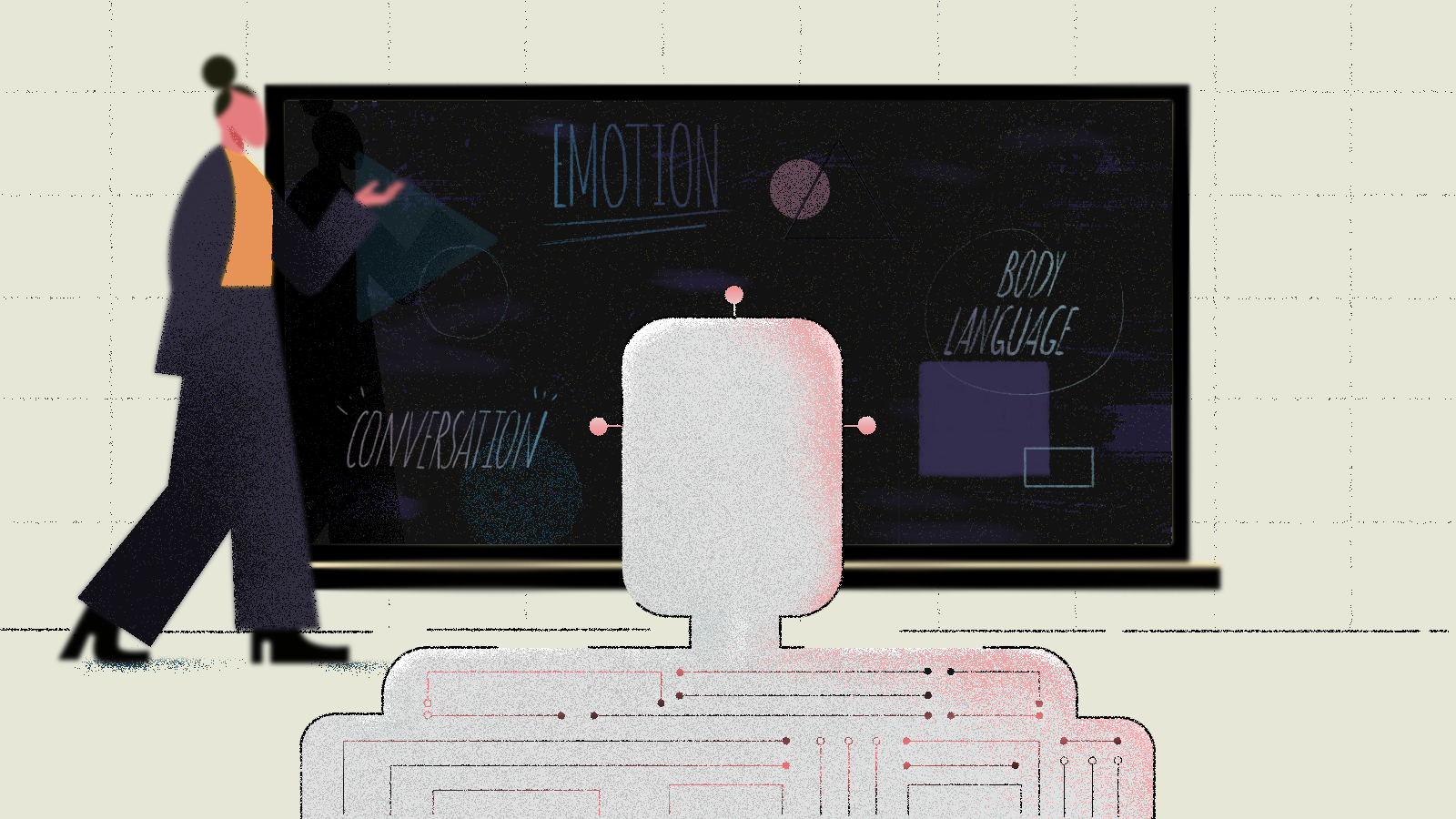
We should just be grateful that we don’t need to learn a new language to interact with this new technology. We just need to get used to speaking it with somebody — or better yet, something — that is still learning to talk. So be patient, be open-minded, and just be yourself. Only then will the future of technology finally take a human shape.This might be the end of the article, but hopefully the beginning of a longer conversation. I’m eager to expand my thinking in this space and would love to hear your perspectives. 🎆
Fore more about this conversation, here’s my latest talk @ CX SF 2019 🕺🏽and podcast at Forrester What It Means series (The Ambiguity-Laden March Toward People-Centric Design). 👋🏽
Illustrations by Helen Slavutsky
When I moved from Mexico to the US, I had difficulties expressing myself in English. And because personal expression is so important to me, I had a lot of frustrating experiences where I longed to use the Spanish words I felt more comfortable with. But I also knew that I wanted to make a life here; I knew that this language was to be my new medium of communication. So I was patient with myself and, thankfully, so too were my new friends and colleagues. 🇲🇽🇺🇸
We’ll all have to be patient with this new conversational technology. We still have a lot of work to do to improve natural language understanding and speech technology. In the meantime, you’re bound to have a few frustrating interactions where, like me in my first years here in the US, you long for your accustomed medium. But deep down, you know the world is changing and many of these interaction models are becoming obsolete. 🌎
We should just be grateful that we don’t need to learn a new language to interact with this new technology. We just need to get used to speaking it with somebody — or better yet, something — that is still learning to talk. So be patient, be open-minded, and just be yourself. Only then will the future of technology finally take a human shape.This might be the end of the article, but hopefully the beginning of a longer conversation. I’m eager to expand my thinking in this space and would love to hear your perspectives. 🎆
Fore more about this conversation, here’s my latest talk @ CX SF 2019 🕺🏽and podcast at Forrester What It Means series (The Ambiguity-Laden March Toward People-Centric Design). 👋🏽
Illustrations by Helen Slavutsky
When I moved from Mexico to the US, I had difficulties expressing myself in English. And because personal expression is so important to me, I had a lot of frustrating experiences where I longed to use the Spanish words I felt more comfortable with. But I also knew that I wanted to make a life here; I knew that this language was to be my new medium of communication. So I was patient with myself and, thankfully, so too were my new friends and colleagues. 🇲🇽🇺🇸
We’ll all have to be patient with this new conversational technology. We still have a lot of work to do to improve natural language understanding and speech technology. In the meantime, you’re bound to have a few frustrating interactions where, like me in my first years here in the US, you long for your accustomed medium. But deep down, you know the world is changing and many of these interaction models are becoming obsolete. 🌎
We should just be grateful that we don’t need to learn a new language to interact with this new technology. We just need to get used to speaking it with somebody — or better yet, something — that is still learning to talk. So be patient, be open-minded, and just be yourself. Only then will the future of technology finally take a human shape.This might be the end of the article, but hopefully the beginning of a longer conversation. I’m eager to expand my thinking in this space and would love to hear your perspectives. 🎆
Fore more about this conversation, here’s my latest talk @ CX SF 2019 🕺🏽and podcast at Forrester What It Means series (The Ambiguity-Laden March Toward People-Centric Design). 👋🏽
Illustrations by Helen Slavutsky
When I moved from Mexico to the US, I had difficulties expressing myself in English. And because personal expression is so important to me, I had a lot of frustrating experiences where I longed to use the Spanish words I felt more comfortable with. But I also knew that I wanted to make a life here; I knew that this language was to be my new medium of communication. So I was patient with myself and, thankfully, so too were my new friends and colleagues. 🇲🇽🇺🇸
We’ll all have to be patient with this new conversational technology. We still have a lot of work to do to improve natural language understanding and speech technology. In the meantime, you’re bound to have a few frustrating interactions where, like me in my first years here in the US, you long for your accustomed medium. But deep down, you know the world is changing and many of these interaction models are becoming obsolete. 🌎
We should just be grateful that we don’t need to learn a new language to interact with this new technology. We just need to get used to speaking it with somebody — or better yet, something — that is still learning to talk. So be patient, be open-minded, and just be yourself. Only then will the future of technology finally take a human shape.This might be the end of the article, but hopefully the beginning of a longer conversation. I’m eager to expand my thinking in this space and would love to hear your perspectives. 🎆
Fore more about this conversation, here’s my latest talk @ CX SF 2019 🕺🏽and podcast at Forrester What It Means series (The Ambiguity-Laden March Toward People-Centric Design). 👋🏽
Illustrations by Helen Slavutsky
When I moved from Mexico to the US, I had difficulties expressing myself in English. And because personal expression is so important to me, I had a lot of frustrating experiences where I longed to use the Spanish words I felt more comfortable with. But I also knew that I wanted to make a life here; I knew that this language was to be my new medium of communication. So I was patient with myself and, thankfully, so too were my new friends and colleagues. 🇲🇽🇺🇸
We’ll all have to be patient with this new conversational technology. We still have a lot of work to do to improve natural language understanding and speech technology. In the meantime, you’re bound to have a few frustrating interactions where, like me in my first years here in the US, you long for your accustomed medium. But deep down, you know the world is changing and many of these interaction models are becoming obsolete. 🌎
We should just be grateful that we don’t need to learn a new language to interact with this new technology. We just need to get used to speaking it with somebody — or better yet, something — that is still learning to talk. So be patient, be open-minded, and just be yourself. Only then will the future of technology finally take a human shape.This might be the end of the article, but hopefully the beginning of a longer conversation. I’m eager to expand my thinking in this space and would love to hear your perspectives. 🎆
Fore more about this conversation, here’s my latest talk @ CX SF 2019 🕺🏽and podcast at Forrester What It Means series (The Ambiguity-Laden March Toward People-Centric Design). 👋🏽
Illustrations by Helen Slavutsky
When I moved from Mexico to the US, I had difficulties expressing myself in English. And because personal expression is so important to me, I had a lot of frustrating experiences where I longed to use the Spanish words I felt more comfortable with. But I also knew that I wanted to make a life here; I knew that this language was to be my new medium of communication. So I was patient with myself and, thankfully, so too were my new friends and colleagues. 🇲🇽🇺🇸
We’ll all have to be patient with this new conversational technology. We still have a lot of work to do to improve natural language understanding and speech technology. In the meantime, you’re bound to have a few frustrating interactions where, like me in my first years here in the US, you long for your accustomed medium. But deep down, you know the world is changing and many of these interaction models are becoming obsolete. 🌎
We should just be grateful that we don’t need to learn a new language to interact with this new technology. We just need to get used to speaking it with somebody — or better yet, something — that is still learning to talk. So be patient, be open-minded, and just be yourself. Only then will the future of technology finally take a human shape.This might be the end of the article, but hopefully the beginning of a longer conversation. I’m eager to expand my thinking in this space and would love to hear your perspectives. 🎆
Fore more about this conversation, here’s my latest talk @ CX SF 2019 🕺🏽and podcast at Forrester What It Means series (The Ambiguity-Laden March Toward People-Centric Design). 👋🏽
Illustrations by Helen Slavutsky
When I moved from Mexico to the US, I had difficulties expressing myself in English. And because personal expression is so important to me, I had a lot of frustrating experiences where I longed to use the Spanish words I felt more comfortable with. But I also knew that I wanted to make a life here; I knew that this language was to be my new medium of communication. So I was patient with myself and, thankfully, so too were my new friends and colleagues. 🇲🇽🇺🇸
We’ll all have to be patient with this new conversational technology. We still have a lot of work to do to improve natural language understanding and speech technology. In the meantime, you’re bound to have a few frustrating interactions where, like me in my first years here in the US, you long for your accustomed medium. But deep down, you know the world is changing and many of these interaction models are becoming obsolete. 🌎
We should just be grateful that we don’t need to learn a new language to interact with this new technology. We just need to get used to speaking it with somebody — or better yet, something — that is still learning to talk. So be patient, be open-minded, and just be yourself. Only then will the future of technology finally take a human shape.This might be the end of the article, but hopefully the beginning of a longer conversation. I’m eager to expand my thinking in this space and would love to hear your perspectives. 🎆
Fore more about this conversation, here’s my latest talk @ CX SF 2019 🕺🏽and podcast at Forrester What It Means series (The Ambiguity-Laden March Toward People-Centric Design). 👋🏽
Illustrations by Helen Slavutsky
When I moved from Mexico to the US, I had difficulties expressing myself in English. And because personal expression is so important to me, I had a lot of frustrating experiences where I longed to use the Spanish words I felt more comfortable with. But I also knew that I wanted to make a life here; I knew that this language was to be my new medium of communication. So I was patient with myself and, thankfully, so too were my new friends and colleagues. 🇲🇽🇺🇸
We’ll all have to be patient with this new conversational technology. We still have a lot of work to do to improve natural language understanding and speech technology. In the meantime, you’re bound to have a few frustrating interactions where, like me in my first years here in the US, you long for your accustomed medium. But deep down, you know the world is changing and many of these interaction models are becoming obsolete. 🌎
We should just be grateful that we don’t need to learn a new language to interact with this new technology. We just need to get used to speaking it with somebody — or better yet, something — that is still learning to talk. So be patient, be open-minded, and just be yourself. Only then will the future of technology finally take a human shape.This might be the end of the article, but hopefully the beginning of a longer conversation. I’m eager to expand my thinking in this space and would love to hear your perspectives. 🎆
Fore more about this conversation, here’s my latest talk @ CX SF 2019 🕺🏽and podcast at Forrester What It Means series (The Ambiguity-Laden March Toward People-Centric Design). 👋🏽
Illustrations by Helen Slavutsky
When I moved from Mexico to the US, I had difficulties expressing myself in English. And because personal expression is so important to me, I had a lot of frustrating experiences where I longed to use the Spanish words I felt more comfortable with. But I also knew that I wanted to make a life here; I knew that this language was to be my new medium of communication. So I was patient with myself and, thankfully, so too were my new friends and colleagues. 🇲🇽🇺🇸
We’ll all have to be patient with this new conversational technology. We still have a lot of work to do to improve natural language understanding and speech technology. In the meantime, you’re bound to have a few frustrating interactions where, like me in my first years here in the US, you long for your accustomed medium. But deep down, you know the world is changing and many of these interaction models are becoming obsolete. 🌎
We should just be grateful that we don’t need to learn a new language to interact with this new technology. We just need to get used to speaking it with somebody — or better yet, something — that is still learning to talk. So be patient, be open-minded, and just be yourself. Only then will the future of technology finally take a human shape.This might be the end of the article, but hopefully the beginning of a longer conversation. I’m eager to expand my thinking in this space and would love to hear your perspectives. 🎆
Fore more about this conversation, here’s my latest talk @ CX SF 2019 🕺🏽and podcast at Forrester What It Means series (The Ambiguity-Laden March Toward People-Centric Design). 👋🏽
Illustrations by Helen Slavutsky
When I moved from Mexico to the US, I had difficulties expressing myself in English. And because personal expression is so important to me, I had a lot of frustrating experiences where I longed to use the Spanish words I felt more comfortable with. But I also knew that I wanted to make a life here; I knew that this language was to be my new medium of communication. So I was patient with myself and, thankfully, so too were my new friends and colleagues. 🇲🇽🇺🇸
We’ll all have to be patient with this new conversational technology. We still have a lot of work to do to improve natural language understanding and speech technology. In the meantime, you’re bound to have a few frustrating interactions where, like me in my first years here in the US, you long for your accustomed medium. But deep down, you know the world is changing and many of these interaction models are becoming obsolete. 🌎
We should just be grateful that we don’t need to learn a new language to interact with this new technology. We just need to get used to speaking it with somebody — or better yet, something — that is still learning to talk. So be patient, be open-minded, and just be yourself. Only then will the future of technology finally take a human shape.This might be the end of the article, but hopefully the beginning of a longer conversation. I’m eager to expand my thinking in this space and would love to hear your perspectives. 🎆
Fore more about this conversation, here’s my latest talk @ CX SF 2019 🕺🏽and podcast at Forrester What It Means series (The Ambiguity-Laden March Toward People-Centric Design). 👋🏽
Illustrations by Helen Slavutsky
When I moved from Mexico to the US, I had difficulties expressing myself in English. And because personal expression is so important to me, I had a lot of frustrating experiences where I longed to use the Spanish words I felt more comfortable with. But I also knew that I wanted to make a life here; I knew that this language was to be my new medium of communication. So I was patient with myself and, thankfully, so too were my new friends and colleagues. 🇲🇽🇺🇸
We’ll all have to be patient with this new conversational technology. We still have a lot of work to do to improve natural language understanding and speech technology. In the meantime, you’re bound to have a few frustrating interactions where, like me in my first years here in the US, you long for your accustomed medium. But deep down, you know the world is changing and many of these interaction models are becoming obsolete. 🌎
We should just be grateful that we don’t need to learn a new language to interact with this new technology. We just need to get used to speaking it with somebody — or better yet, something — that is still learning to talk. So be patient, be open-minded, and just be yourself. Only then will the future of technology finally take a human shape.This might be the end of the article, but hopefully the beginning of a longer conversation. I’m eager to expand my thinking in this space and would love to hear your perspectives. 🎆
Fore more about this conversation, here’s my latest talk @ CX SF 2019 🕺🏽and podcast at Forrester What It Means series (The Ambiguity-Laden March Toward People-Centric Design). 👋🏽
Illustrations by Helen Slavutsky
When I moved from Mexico to the US, I had difficulties expressing myself in English. And because personal expression is so important to me, I had a lot of frustrating experiences where I longed to use the Spanish words I felt more comfortable with. But I also knew that I wanted to make a life here; I knew that this language was to be my new medium of communication. So I was patient with myself and, thankfully, so too were my new friends and colleagues. 🇲🇽🇺🇸
We’ll all have to be patient with this new conversational technology. We still have a lot of work to do to improve natural language understanding and speech technology. In the meantime, you’re bound to have a few frustrating interactions where, like me in my first years here in the US, you long for your accustomed medium. But deep down, you know the world is changing and many of these interaction models are becoming obsolete. 🌎
We should just be grateful that we don’t need to learn a new language to interact with this new technology. We just need to get used to speaking it with somebody — or better yet, something — that is still learning to talk. So be patient, be open-minded, and just be yourself. Only then will the future of technology finally take a human shape.This might be the end of the article, but hopefully the beginning of a longer conversation. I’m eager to expand my thinking in this space and would love to hear your perspectives. 🎆
Fore more about this conversation, here’s my latest talk @ CX SF 2019 🕺🏽and podcast at Forrester What It Means series (The Ambiguity-Laden March Toward People-Centric Design). 👋🏽
Illustrations by Helen Slavutsky
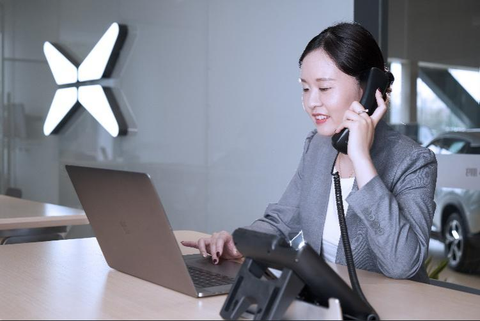
Xpeng provides full-service with national coverage, for any incident along the road. Our customer service hotline at 41 45 97 97 is staffed 24/7.
If you require any assistance on the road, Xpeng Assistance is ready to respond 24/7. We provide help-on-phone and can dispatch support to your location at any time to ensure you and your vehicle are taken well care of.
When I moved from Mexico to the US, I had difficulties expressing myself in English. And because personal expression is so important to me, I had a lot of frustrating experiences where I longed to use the Spanish words I felt more comfortable with. But I also knew that I wanted to make a life here; I knew that this language was to be my new medium of communication. So I was patient with myself and, thankfully, so too were my new friends and colleagues. 🇲🇽🇺🇸
We’ll all have to be patient with this new conversational technology. We still have a lot of work to do to improve natural language understanding and speech technology. In the meantime, you’re bound to have a few frustrating interactions where, like me in my first years here in the US, you long for your accustomed medium. But deep down, you know the world is changing and many of these interaction models are becoming obsolete. 🌎
We should just be grateful that we don’t need to learn a new language to interact with this new technology. We just need to get used to speaking it with somebody — or better yet, something — that is still learning to talk. So be patient, be open-minded, and just be yourself. Only then will the future of technology finally take a human shape.This might be the end of the article, but hopefully the beginning of a longer conversation. I’m eager to expand my thinking in this space and would love to hear your perspectives. 🎆
Fore more about this conversation, here’s my latest talk @ CX SF 2019 🕺🏽and podcast at Forrester What It Means series (The Ambiguity-Laden March Toward People-Centric Design). 👋🏽
Illustrations by Helen Slavutsky
do yourself , let's go, try your best to do!
blog-dev2 is different blog type!

akjf ljai is shome wo me you jis
blog-dev2 is different blog type!
“We challenge our students to think big — we want them to make a positive difference in the world,” says Kinley. “It’s our job to equip them with the necessary knowledge and skills they’ll need to thrive. We know we can do that by fostering independent and self-directed learners, and iPad is a key tool in this mission.”
At Bromley School, every teacher and middle school student has their own iPad. There’s an Apple TV in every classroom, and a fleet of Macs for coding. Since introducing iPad, Bromley students are setting the bar for what’s possible when you inspire the minds of young learners. They’re winning regional digital creativity competitions, taking an active role in their learning successes, pitching their ideas to local community groups and investors, and sharing their experience with other schools.
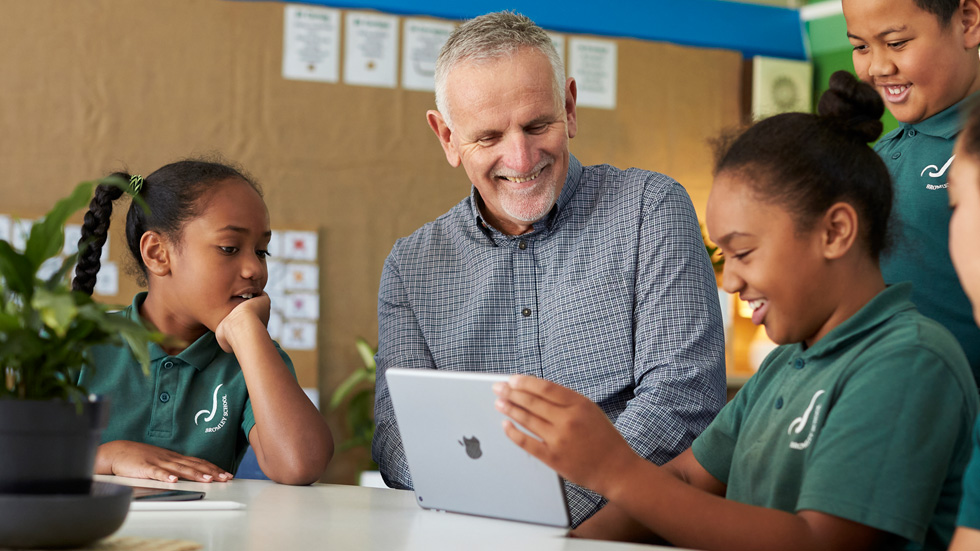
Students Azariah Abohay, Amelia Abohay, and Jeremiah Laufiso show Principal Scot Kinley their app prototype, built in Keynote, which allowed them to combine text, drawings, audio recordings, animations and hyperlinks.
“Tālofa lava, e te tautala Gagana Sāmoa?” (“Hello, do you speak Samoan?”)
When their much-loved Samoan language teacher moved to a local high school, many of Bromley’s Samoan students wanted to continue to learn Gagana Sāmoa — the language of the Samoan Islands — but no replacement teachers were available.
“A lot of our students’ parents or grandparents are fluent in their home language, but some of our students just know the basics — I had the same experience growing up,” explains Mele Togiaso, a teacher at Bromley School. “I'm part Māori and part Samoan, and I’m only now learning my family languages as an adult, thanks to a passionate group of kids!”
A group of students from years 3 through 6 (ages 8 through 11) asked Togiaso to help them find a way to continue their lessons. Together, they formed an inquiry group — the Digi Navigators — and started exploring apps, books, and websites they thought might help. Unfortunately, nothing fit their needs. Some apps relied too heavily on text for younger learners, some didn’t provide audio to help with pronunciation or images to help with comprehension, and some didn’t include fun games to keep students engaged and on track. The Digi Navigators were undeterred.
Bromley’s Pasifika students turned to teacher Mele Togiaso to help them find a way to continue their Samoan lessons. Togiaso used Apple’s App Design Journal to help guide the group through the app development process. Togiaso checks on students Amelia Abohay and Jeremiah Laufiso’s progress. “Tātou a’oa’o Gagana Sāmoa!” (“Let’s learn Samoan!”)
“We decided to create a prototype for an app called Let’s Learn Samoan, because all of the kids at our school have access to iPad and we wanted it to be accessible to everyone,” says Jeremiah Laufiso, a year 5 student.
The Digi Navigators created their app prototype in Keynote, the powerful presentation tool that comes included with most Apple devices, because it allowed them to combine text, drawings, audio recordings, animations, and hyperlinks in one place — all essential elements of their dream app. Togiaso used the App Design Journal from the Everyone Can Code curriculum, available as a free download from Apple, to help guide the group through the app development process. “It’s super helpful,” Togiaso says. “I share the Journal with anyone that asks how we created our app, because it provides such an easy, step-by-step process to follow.”
Bromley School student Azariah Abohay uses Apple Pencil and the Adobe Photoshop Sketch app to create an original illustration of a fale (a traditional Samoan building) for the app.
The Bromley School students sketched illustrations with Apple Pencil, created animations in Keynote, and recorded voice overs using the iPad’s built-in microphone.
After brainstorming ideas and creating wireframes for their app, the students divided into content creation teams, sketching illustrations with Apple Pencil, creating animations in Keynote, and recording voice overs using the iPad’s built-in microphone.
Testing was also an important part of the process. “This is where we discovered bugs in our prototype, and got feedback on how we could improve our app,” says Amelia Abohay, a year 6 student. “A lot of different groups around our school helped by telling us what they liked and didn’t like, and giving us ideas for how we could make it even better.”
The Digi Navigators also met with a Gagana Sāmoa expert from their community. “This was really valuable because he gave us feedback on our pronunciation, and even more ideas about what we could include,” Amelia says.
“My mission is to inspire a new generation of Pacific nations and Māori leaders in the tech industry,” said Togiaso. “These groups are underrepresented in tech today, and we have so much to offer. I want our kids to see careers in tech as a genuine pathway in their future.” In September 2020, the Digi Navigators were invited to pitch their idea at an event designed to increase opportunities for the next generation of Pacific nations tech innovators. In front of an audience of 50 local tech experts, investors, and teachers, five Digi Navigators presented their business case, demonstrated the app prototype, and answered questions from the crowd. They also received feedback from a local angel investor that has promised to provide continued support and mentorship to grow their idea.
“It was really cool to be able to teach our friends to speak Samoan using an app that we designed ourselves,” says Leonie Bradbrook, a year 6 student. “I would love to create more apps and help my friends.”
Back in regular lessons and at home, the Digi Navigators’ teachers and parents have noticed the deeper connection the students have forged with their culture, and their improved sense of themselves as capable and confident creators.
“In Pacific cultures, we achieve together,” says Togiaso. “It’s not about any one individual’s success — nobody is left behind. This experience showed our students that it is not enough for a smaller team to excel. For everyone to achieve, they all had to collaborate and make sure everybody was doing well.
Ya sea que necesite actualizar manualmente el software de su REDMAGIC o actualizar su dispositivo con la ROM global, siga las instrucciones a continuación.
NOTAS:
We really took a pounding.
#1: Cael's High School Beating
#2: Sam's High School Beating
#3: Karl's High School Beating
Imagine, for a second, you relied on a standard office printer to print out weekly reports. Nowadays, even your run-of-the-mill printer has countless fancy features. And yet, come Friday, you shuffle over to the printer and push, by sheer force of habit, the same buttons in the same sequence to get the same result. Naturally, your report is never formatted exactly how you wanted (perhaps the margins are too narrow or the images are too dark), so you just accept the result because it would be too time-consuming to figure out how to get the thing to do exactly what you want it to. Nobody likes doing this type of tedious work, which is why it usually got passed off on me back when I was an intern: “Hey Hector, can you print this out for me, same as last week but just skip the images?” I couldn’t delegate this to somebody else, because the only thing lower in the hierarchy than me was, well, the printer. 🖨
But imagine how enjoyable my internship would’ve been if I could’ve talked to my printer. Nowadays, some smart printers can already handle basic voice commands, eliminating some of the inefficient button pushing. But what if these smart printers could take it a step further and carry on a context-sensitive conversation that accounts for changing needs? It might, for instance, make helpful suggestions like, “It looks like you’re just printing a quick draft, so should I make it black and white to save some ink?” This would make it more than just a useful tool, but an assistive agent. 💥
alkfjalk akfji on your home is good woud
akfdla;lfkl
alkjfa;lsdfk
afjalsjfl;
When I moved from Mexico to the US, I had difficulties expressing myself in English. And because personal expression is so important to me, I had a lot of frustrating experiences where I longed to use the Spanish words I felt more comfortable with. But I also knew that I wanted to make a life here; I knew that this language was to be my new medium of communication. So I was patient with myself and, thankfully, so too were my new friends and colleagues. 🇲🇽🇺🇸
We’ll all have to be patient with this new conversational technology. We still have a lot of work to do to improve natural language understanding and speech technology. In the meantime, you’re bound to have a few frustrating interactions where, like me in my first years here in the US, you long for your accustomed medium. But deep down, you know the world is changing and many of these interaction models are becoming obsolete. 🌎
We should just be grateful that we don’t need to learn a new language to interact with this new technology. We just need to get used to speaking it with somebody — or better yet, something — that is still learning to talk. So be patient, be open-minded, and just be yourself. Only then will the future of technology finally take a human shape.This might be the end of the article, but hopefully the beginning of a longer conversation. I’m eager to expand my thinking in this space and would love to hear your perspectives. 🎆
Fore more about this conversation, here’s my latest talk @ CX SF 2019 🕺🏽and podcast at Forrester What It Means series (The Ambiguity-Laden March Toward People-Centric Design). 👋🏽
Illustrations by Helen Slavutsky
When I moved from Mexico to the US, I had difficulties expressing myself in English. And because personal expression is so important to me, I had a lot of frustrating experiences where I longed to use the Spanish words I felt more comfortable with. But I also knew that I wanted to make a life here; I knew that this language was to be my new medium of communication. So I was patient with myself and, thankfully, so too were my new friends and colleagues. 🇲🇽🇺🇸
We’ll all have to be patient with this new conversational technology. We still have a lot of work to do to improve natural language understanding and speech technology. In the meantime, you’re bound to have a few frustrating interactions where, like me in my first years here in the US, you long for your accustomed medium. But deep down, you know the world is changing and many of these interaction models are becoming obsolete. 🌎
We should just be grateful that we don’t need to learn a new language to interact with this new technology. We just need to get used to speaking it with somebody — or better yet, something — that is still learning to talk. So be patient, be open-minded, and just be yourself. Only then will the future of technology finally take a human shape.This might be the end of the article, but hopefully the beginning of a longer conversation. I’m eager to expand my thinking in this space and would love to hear your perspectives. 🎆
Fore more about this conversation, here’s my latest talk @ CX SF 2019 🕺🏽and podcast at Forrester What It Means series (The Ambiguity-Laden March Toward People-Centric Design). 👋🏽
Illustrations by Helen Slavutsky
When I moved from Mexico to the US, I had difficulties expressing myself in English. And because personal expression is so important to me, I had a lot of frustrating experiences where I longed to use the Spanish words I felt more comfortable with. But I also knew that I wanted to make a life here; I knew that this language was to be my new medium of communication. So I was patient with myself and, thankfully, so too were my new friends and colleagues. 🇲🇽🇺🇸
We’ll all have to be patient with this new conversational technology. We still have a lot of work to do to improve natural language understanding and speech technology. In the meantime, you’re bound to have a few frustrating interactions where, like me in my first years here in the US, you long for your accustomed medium. But deep down, you know the world is changing and many of these interaction models are becoming obsolete. 🌎
We should just be grateful that we don’t need to learn a new language to interact with this new technology. We just need to get used to speaking it with somebody — or better yet, something — that is still learning to talk. So be patient, be open-minded, and just be yourself. Only then will the future of technology finally take a human shape.This might be the end of the article, but hopefully the beginning of a longer conversation. I’m eager to expand my thinking in this space and would love to hear your perspectives. 🎆
Fore more about this conversation, here’s my latest talk @ CX SF 2019 🕺🏽and podcast at Forrester What It Means series (The Ambiguity-Laden March Toward People-Centric Design). 👋🏽
Illustrations by Helen Slavutsky
When I moved from Mexico to the US, I had difficulties expressing myself in English. And because personal expression is so important to me, I had a lot of frustrating experiences where I longed to use the Spanish words I felt more comfortable with. But I also knew that I wanted to make a life here; I knew that this language was to be my new medium of communication. So I was patient with myself and, thankfully, so too were my new friends and colleagues. 🇲🇽🇺🇸
We’ll all have to be patient with this new conversational technology. We still have a lot of work to do to improve natural language understanding and speech technology. In the meantime, you’re bound to have a few frustrating interactions where, like me in my first years here in the US, you long for your accustomed medium. But deep down, you know the world is changing and many of these interaction models are becoming obsolete. 🌎
We should just be grateful that we don’t need to learn a new language to interact with this new technology. We just need to get used to speaking it with somebody — or better yet, something — that is still learning to talk. So be patient, be open-minded, and just be yourself. Only then will the future of technology finally take a human shape.This might be the end of the article, but hopefully the beginning of a longer conversation. I’m eager to expand my thinking in this space and would love to hear your perspectives. 🎆
Fore more about this conversation, here’s my latest talk @ CX SF 2019 🕺🏽and podcast at Forrester What It Means series (The Ambiguity-Laden March Toward People-Centric Design). 👋🏽
Illustrations by Helen Slavutsky
When I moved from Mexico to the US, I had difficulties expressing myself in English. And because personal expression is so important to me, I had a lot of frustrating experiences where I longed to use the Spanish words I felt more comfortable with. But I also knew that I wanted to make a life here; I knew that this language was to be my new medium of communication. So I was patient with myself and, thankfully, so too were my new friends and colleagues. 🇲🇽🇺🇸
We’ll all have to be patient with this new conversational technology. We still have a lot of work to do to improve natural language understanding and speech technology. In the meantime, you’re bound to have a few frustrating interactions where, like me in my first years here in the US, you long for your accustomed medium. But deep down, you know the world is changing and many of these interaction models are becoming obsolete. 🌎
We should just be grateful that we don’t need to learn a new language to interact with this new technology. We just need to get used to speaking it with somebody — or better yet, something — that is still learning to talk. So be patient, be open-minded, and just be yourself. Only then will the future of technology finally take a human shape.This might be the end of the article, but hopefully the beginning of a longer conversation. I’m eager to expand my thinking in this space and would love to hear your perspectives. 🎆
Fore more about this conversation, here’s my latest talk @ CX SF 2019 🕺🏽and podcast at Forrester What It Means series (The Ambiguity-Laden March Toward People-Centric Design). 👋🏽
Illustrations by Helen Slavutsky
When I moved from Mexico to the US, I had difficulties expressing myself in English. And because personal expression is so important to me, I had a lot of frustrating experiences where I longed to use the Spanish words I felt more comfortable with. But I also knew that I wanted to make a life here; I knew that this language was to be my new medium of communication. So I was patient with myself and, thankfully, so too were my new friends and colleagues. 🇲🇽🇺🇸
We’ll all have to be patient with this new conversational technology. We still have a lot of work to do to improve natural language understanding and speech technology. In the meantime, you’re bound to have a few frustrating interactions where, like me in my first years here in the US, you long for your accustomed medium. But deep down, you know the world is changing and many of these interaction models are becoming obsolete. 🌎
We should just be grateful that we don’t need to learn a new language to interact with this new technology. We just need to get used to speaking it with somebody — or better yet, something — that is still learning to talk. So be patient, be open-minded, and just be yourself. Only then will the future of technology finally take a human shape.This might be the end of the article, but hopefully the beginning of a longer conversation. I’m eager to expand my thinking in this space and would love to hear your perspectives. 🎆
Fore more about this conversation, here’s my latest talk @ CX SF 2019 🕺🏽and podcast at Forrester What It Means series (The Ambiguity-Laden March Toward People-Centric Design). 👋🏽
Illustrations by Helen Slavutsky
When I moved from Mexico to the US, I had difficulties expressing myself in English. And because personal expression is so important to me, I had a lot of frustrating experiences where I longed to use the Spanish words I felt more comfortable with. But I also knew that I wanted to make a life here; I knew that this language was to be my new medium of communication. So I was patient with myself and, thankfully, so too were my new friends and colleagues. 🇲🇽🇺🇸
We’ll all have to be patient with this new conversational technology. We still have a lot of work to do to improve natural language understanding and speech technology. In the meantime, you’re bound to have a few frustrating interactions where, like me in my first years here in the US, you long for your accustomed medium. But deep down, you know the world is changing and many of these interaction models are becoming obsolete. 🌎
We should just be grateful that we don’t need to learn a new language to interact with this new technology. We just need to get used to speaking it with somebody — or better yet, something — that is still learning to talk. So be patient, be open-minded, and just be yourself. Only then will the future of technology finally take a human shape.This might be the end of the article, but hopefully the beginning of a longer conversation. I’m eager to expand my thinking in this space and would love to hear your perspectives. 🎆
Fore more about this conversation, here’s my latest talk @ CX SF 2019 🕺🏽and podcast at Forrester What It Means series (The Ambiguity-Laden March Toward People-Centric Design). 👋🏽
Illustrations by Helen Slavutsky
When I moved from Mexico to the US, I had difficulties expressing myself in English. And because personal expression is so important to me, I had a lot of frustrating experiences where I longed to use the Spanish words I felt more comfortable with. But I also knew that I wanted to make a life here; I knew that this language was to be my new medium of communication. So I was patient with myself and, thankfully, so too were my new friends and colleagues. 🇲🇽🇺🇸
We’ll all have to be patient with this new conversational technology. We still have a lot of work to do to improve natural language understanding and speech technology. In the meantime, you’re bound to have a few frustrating interactions where, like me in my first years here in the US, you long for your accustomed medium. But deep down, you know the world is changing and many of these interaction models are becoming obsolete. 🌎
We should just be grateful that we don’t need to learn a new language to interact with this new technology. We just need to get used to speaking it with somebody — or better yet, something — that is still learning to talk. So be patient, be open-minded, and just be yourself. Only then will the future of technology finally take a human shape.This might be the end of the article, but hopefully the beginning of a longer conversation. I’m eager to expand my thinking in this space and would love to hear your perspectives. 🎆
Fore more about this conversation, here’s my latest talk @ CX SF 2019 🕺🏽and podcast at Forrester What It Means series (The Ambiguity-Laden March Toward People-Centric Design). 👋🏽
Illustrations by Helen Slavutsky
When I moved from Mexico to the US, I had difficulties expressing myself in English. And because personal expression is so important to me, I had a lot of frustrating experiences where I longed to use the Spanish words I felt more comfortable with. But I also knew that I wanted to make a life here; I knew that this language was to be my new medium of communication. So I was patient with myself and, thankfully, so too were my new friends and colleagues. 🇲🇽🇺🇸
We’ll all have to be patient with this new conversational technology. We still have a lot of work to do to improve natural language understanding and speech technology. In the meantime, you’re bound to have a few frustrating interactions where, like me in my first years here in the US, you long for your accustomed medium. But deep down, you know the world is changing and many of these interaction models are becoming obsolete. 🌎
We should just be grateful that we don’t need to learn a new language to interact with this new technology. We just need to get used to speaking it with somebody — or better yet, something — that is still learning to talk. So be patient, be open-minded, and just be yourself. Only then will the future of technology finally take a human shape.This might be the end of the article, but hopefully the beginning of a longer conversation. I’m eager to expand my thinking in this space and would love to hear your perspectives. 🎆
Fore more about this conversation, here’s my latest talk @ CX SF 2019 🕺🏽and podcast at Forrester What It Means series (The Ambiguity-Laden March Toward People-Centric Design). 👋🏽
Illustrations by Helen Slavutsky
When I moved from Mexico to the US, I had difficulties expressing myself in English. And because personal expression is so important to me, I had a lot of frustrating experiences where I longed to use the Spanish words I felt more comfortable with. But I also knew that I wanted to make a life here; I knew that this language was to be my new medium of communication. So I was patient with myself and, thankfully, so too were my new friends and colleagues. 🇲🇽🇺🇸
We’ll all have to be patient with this new conversational technology. We still have a lot of work to do to improve natural language understanding and speech technology. In the meantime, you’re bound to have a few frustrating interactions where, like me in my first years here in the US, you long for your accustomed medium. But deep down, you know the world is changing and many of these interaction models are becoming obsolete. 🌎
We should just be grateful that we don’t need to learn a new language to interact with this new technology. We just need to get used to speaking it with somebody — or better yet, something — that is still learning to talk. So be patient, be open-minded, and just be yourself. Only then will the future of technology finally take a human shape.This might be the end of the article, but hopefully the beginning of a longer conversation. I’m eager to expand my thinking in this space and would love to hear your perspectives. 🎆
Fore more about this conversation, here’s my latest talk @ CX SF 2019 🕺🏽and podcast at Forrester What It Means series (The Ambiguity-Laden March Toward People-Centric Design). 👋🏽
Illustrations by Helen Slavutsky
When I moved from Mexico to the US, I had difficulties expressing myself in English. And because personal expression is so important to me, I had a lot of frustrating experiences where I longed to use the Spanish words I felt more comfortable with. But I also knew that I wanted to make a life here; I knew that this language was to be my new medium of communication. So I was patient with myself and, thankfully, so too were my new friends and colleagues. 🇲🇽🇺🇸
We’ll all have to be patient with this new conversational technology. We still have a lot of work to do to improve natural language understanding and speech technology. In the meantime, you’re bound to have a few frustrating interactions where, like me in my first years here in the US, you long for your accustomed medium. But deep down, you know the world is changing and many of these interaction models are becoming obsolete. 🌎
We should just be grateful that we don’t need to learn a new language to interact with this new technology. We just need to get used to speaking it with somebody — or better yet, something — that is still learning to talk. So be patient, be open-minded, and just be yourself. Only then will the future of technology finally take a human shape.This might be the end of the article, but hopefully the beginning of a longer conversation. I’m eager to expand my thinking in this space and would love to hear your perspectives. 🎆
Fore more about this conversation, here’s my latest talk @ CX SF 2019 🕺🏽and podcast at Forrester What It Means series (The Ambiguity-Laden March Toward People-Centric Design). 👋🏽
Illustrations by Helen Slavutsky
When I moved from Mexico to the US, I had difficulties expressing myself in English. And because personal expression is so important to me, I had a lot of frustrating experiences where I longed to use the Spanish words I felt more comfortable with. But I also knew that I wanted to make a life here; I knew that this language was to be my new medium of communication. So I was patient with myself and, thankfully, so too were my new friends and colleagues. 🇲🇽🇺🇸
We’ll all have to be patient with this new conversational technology. We still have a lot of work to do to improve natural language understanding and speech technology. In the meantime, you’re bound to have a few frustrating interactions where, like me in my first years here in the US, you long for your accustomed medium. But deep down, you know the world is changing and many of these interaction models are becoming obsolete. 🌎
We should just be grateful that we don’t need to learn a new language to interact with this new technology. We just need to get used to speaking it with somebody — or better yet, something — that is still learning to talk. So be patient, be open-minded, and just be yourself. Only then will the future of technology finally take a human shape.This might be the end of the article, but hopefully the beginning of a longer conversation. I’m eager to expand my thinking in this space and would love to hear your perspectives. 🎆
Fore more about this conversation, here’s my latest talk @ CX SF 2019 🕺🏽and podcast at Forrester What It Means series (The Ambiguity-Laden March Toward People-Centric Design). 👋🏽
Illustrations by Helen Slavutsky
Xpeng provides full-service with national coverage, for any incident along the road. Our customer service hotline at 41 45 97 97 is staffed 24/7.
If you require any assistance on the road, Xpeng Assistance is ready to respond 24/7. We provide help-on-phone and can dispatch support to your location at any time to ensure you and your vehicle are taken well care of.
When I moved from Mexico to the US, I had difficulties expressing myself in English. And because personal expression is so important to me, I had a lot of frustrating experiences where I longed to use the Spanish words I felt more comfortable with. But I also knew that I wanted to make a life here; I knew that this language was to be my new medium of communication. So I was patient with myself and, thankfully, so too were my new friends and colleagues. 🇲🇽🇺🇸
We’ll all have to be patient with this new conversational technology. We still have a lot of work to do to improve natural language understanding and speech technology. In the meantime, you’re bound to have a few frustrating interactions where, like me in my first years here in the US, you long for your accustomed medium. But deep down, you know the world is changing and many of these interaction models are becoming obsolete. 🌎
We should just be grateful that we don’t need to learn a new language to interact with this new technology. We just need to get used to speaking it with somebody — or better yet, something — that is still learning to talk. So be patient, be open-minded, and just be yourself. Only then will the future of technology finally take a human shape.This might be the end of the article, but hopefully the beginning of a longer conversation. I’m eager to expand my thinking in this space and would love to hear your perspectives. 🎆
Fore more about this conversation, here’s my latest talk @ CX SF 2019 🕺🏽and podcast at Forrester What It Means series (The Ambiguity-Laden March Toward People-Centric Design). 👋🏽
Illustrations by Helen Slavutsky
do yourself , let's go, try your best to do!
blog-dev2 is different blog type!
akjf ljai is shome wo me you jis
blog-dev2 is different blog type!
“We challenge our students to think big — we want them to make a positive difference in the world,” says Kinley. “It’s our job to equip them with the necessary knowledge and skills they’ll need to thrive. We know we can do that by fostering independent and self-directed learners, and iPad is a key tool in this mission.”
At Bromley School, every teacher and middle school student has their own iPad. There’s an Apple TV in every classroom, and a fleet of Macs for coding. Since introducing iPad, Bromley students are setting the bar for what’s possible when you inspire the minds of young learners. They’re winning regional digital creativity competitions, taking an active role in their learning successes, pitching their ideas to local community groups and investors, and sharing their experience with other schools.
Students Azariah Abohay, Amelia Abohay, and Jeremiah Laufiso show Principal Scot Kinley their app prototype, built in Keynote, which allowed them to combine text, drawings, audio recordings, animations and hyperlinks.
“Tālofa lava, e te tautala Gagana Sāmoa?” (“Hello, do you speak Samoan?”)
When their much-loved Samoan language teacher moved to a local high school, many of Bromley’s Samoan students wanted to continue to learn Gagana Sāmoa — the language of the Samoan Islands — but no replacement teachers were available.
“A lot of our students’ parents or grandparents are fluent in their home language, but some of our students just know the basics — I had the same experience growing up,” explains Mele Togiaso, a teacher at Bromley School. “I'm part Māori and part Samoan, and I’m only now learning my family languages as an adult, thanks to a passionate group of kids!”
A group of students from years 3 through 6 (ages 8 through 11) asked Togiaso to help them find a way to continue their lessons. Together, they formed an inquiry group — the Digi Navigators — and started exploring apps, books, and websites they thought might help. Unfortunately, nothing fit their needs. Some apps relied too heavily on text for younger learners, some didn’t provide audio to help with pronunciation or images to help with comprehension, and some didn’t include fun games to keep students engaged and on track. The Digi Navigators were undeterred.
Bromley’s Pasifika students turned to teacher Mele Togiaso to help them find a way to continue their Samoan lessons. Togiaso used Apple’s App Design Journal to help guide the group through the app development process. Togiaso checks on students Amelia Abohay and Jeremiah Laufiso’s progress. “Tātou a’oa’o Gagana Sāmoa!” (“Let’s learn Samoan!”)
“We decided to create a prototype for an app called Let’s Learn Samoan, because all of the kids at our school have access to iPad and we wanted it to be accessible to everyone,” says Jeremiah Laufiso, a year 5 student.
The Digi Navigators created their app prototype in Keynote, the powerful presentation tool that comes included with most Apple devices, because it allowed them to combine text, drawings, audio recordings, animations, and hyperlinks in one place — all essential elements of their dream app. Togiaso used the App Design Journal from the Everyone Can Code curriculum, available as a free download from Apple, to help guide the group through the app development process. “It’s super helpful,” Togiaso says. “I share the Journal with anyone that asks how we created our app, because it provides such an easy, step-by-step process to follow.”
Bromley School student Azariah Abohay uses Apple Pencil and the Adobe Photoshop Sketch app to create an original illustration of a fale (a traditional Samoan building) for the app.
The Bromley School students sketched illustrations with Apple Pencil, created animations in Keynote, and recorded voice overs using the iPad’s built-in microphone.
After brainstorming ideas and creating wireframes for their app, the students divided into content creation teams, sketching illustrations with Apple Pencil, creating animations in Keynote, and recording voice overs using the iPad’s built-in microphone.
Testing was also an important part of the process. “This is where we discovered bugs in our prototype, and got feedback on how we could improve our app,” says Amelia Abohay, a year 6 student. “A lot of different groups around our school helped by telling us what they liked and didn’t like, and giving us ideas for how we could make it even better.”
The Digi Navigators also met with a Gagana Sāmoa expert from their community. “This was really valuable because he gave us feedback on our pronunciation, and even more ideas about what we could include,” Amelia says.
“My mission is to inspire a new generation of Pacific nations and Māori leaders in the tech industry,” said Togiaso. “These groups are underrepresented in tech today, and we have so much to offer. I want our kids to see careers in tech as a genuine pathway in their future.” In September 2020, the Digi Navigators were invited to pitch their idea at an event designed to increase opportunities for the next generation of Pacific nations tech innovators. In front of an audience of 50 local tech experts, investors, and teachers, five Digi Navigators presented their business case, demonstrated the app prototype, and answered questions from the crowd. They also received feedback from a local angel investor that has promised to provide continued support and mentorship to grow their idea.
“It was really cool to be able to teach our friends to speak Samoan using an app that we designed ourselves,” says Leonie Bradbrook, a year 6 student. “I would love to create more apps and help my friends.”
Back in regular lessons and at home, the Digi Navigators’ teachers and parents have noticed the deeper connection the students have forged with their culture, and their improved sense of themselves as capable and confident creators.
“In Pacific cultures, we achieve together,” says Togiaso. “It’s not about any one individual’s success — nobody is left behind. This experience showed our students that it is not enough for a smaller team to excel. For everyone to achieve, they all had to collaborate and make sure everybody was doing well.
Ya sea que necesite actualizar manualmente el software de su REDMAGIC o actualizar su dispositivo con la ROM global, siga las instrucciones a continuación.
NOTAS:
We really took a pounding.
#1: Cael's High School Beating
#2: Sam's High School Beating
#3: Karl's High School Beating
Imagine, for a second, you relied on a standard office printer to print out weekly reports. Nowadays, even your run-of-the-mill printer has countless fancy features. And yet, come Friday, you shuffle over to the printer and push, by sheer force of habit, the same buttons in the same sequence to get the same result. Naturally, your report is never formatted exactly how you wanted (perhaps the margins are too narrow or the images are too dark), so you just accept the result because it would be too time-consuming to figure out how to get the thing to do exactly what you want it to. Nobody likes doing this type of tedious work, which is why it usually got passed off on me back when I was an intern: “Hey Hector, can you print this out for me, same as last week but just skip the images?” I couldn’t delegate this to somebody else, because the only thing lower in the hierarchy than me was, well, the printer. 🖨
But imagine how enjoyable my internship would’ve been if I could’ve talked to my printer. Nowadays, some smart printers can already handle basic voice commands, eliminating some of the inefficient button pushing. But what if these smart printers could take it a step further and carry on a context-sensitive conversation that accounts for changing needs? It might, for instance, make helpful suggestions like, “It looks like you’re just printing a quick draft, so should I make it black and white to save some ink?” This would make it more than just a useful tool, but an assistive agent. 💥
alkfjalk akfji on your home is good woud
akfdla;lfkl
alkjfa;lsdfk
afjalsjfl;
When I moved from Mexico to the US, I had difficulties expressing myself in English. And because personal expression is so important to me, I had a lot of frustrating experiences where I longed to use the Spanish words I felt more comfortable with. But I also knew that I wanted to make a life here; I knew that this language was to be my new medium of communication. So I was patient with myself and, thankfully, so too were my new friends and colleagues. 🇲🇽🇺🇸
We’ll all have to be patient with this new conversational technology. We still have a lot of work to do to improve natural language understanding and speech technology. In the meantime, you’re bound to have a few frustrating interactions where, like me in my first years here in the US, you long for your accustomed medium. But deep down, you know the world is changing and many of these interaction models are becoming obsolete. 🌎
We should just be grateful that we don’t need to learn a new language to interact with this new technology. We just need to get used to speaking it with somebody — or better yet, something — that is still learning to talk. So be patient, be open-minded, and just be yourself. Only then will the future of technology finally take a human shape.This might be the end of the article, but hopefully the beginning of a longer conversation. I’m eager to expand my thinking in this space and would love to hear your perspectives. 🎆
Fore more about this conversation, here’s my latest talk @ CX SF 2019 🕺🏽and podcast at Forrester What It Means series (The Ambiguity-Laden March Toward People-Centric Design). 👋🏽
Illustrations by Helen Slavutsky
When I moved from Mexico to the US, I had difficulties expressing myself in English. And because personal expression is so important to me, I had a lot of frustrating experiences where I longed to use the Spanish words I felt more comfortable with. But I also knew that I wanted to make a life here; I knew that this language was to be my new medium of communication. So I was patient with myself and, thankfully, so too were my new friends and colleagues. 🇲🇽🇺🇸
We’ll all have to be patient with this new conversational technology. We still have a lot of work to do to improve natural language understanding and speech technology. In the meantime, you’re bound to have a few frustrating interactions where, like me in my first years here in the US, you long for your accustomed medium. But deep down, you know the world is changing and many of these interaction models are becoming obsolete. 🌎
We should just be grateful that we don’t need to learn a new language to interact with this new technology. We just need to get used to speaking it with somebody — or better yet, something — that is still learning to talk. So be patient, be open-minded, and just be yourself. Only then will the future of technology finally take a human shape.This might be the end of the article, but hopefully the beginning of a longer conversation. I’m eager to expand my thinking in this space and would love to hear your perspectives. 🎆
Fore more about this conversation, here’s my latest talk @ CX SF 2019 🕺🏽and podcast at Forrester What It Means series (The Ambiguity-Laden March Toward People-Centric Design). 👋🏽
Illustrations by Helen Slavutsky
When I moved from Mexico to the US, I had difficulties expressing myself in English. And because personal expression is so important to me, I had a lot of frustrating experiences where I longed to use the Spanish words I felt more comfortable with. But I also knew that I wanted to make a life here; I knew that this language was to be my new medium of communication. So I was patient with myself and, thankfully, so too were my new friends and colleagues. 🇲🇽🇺🇸
We’ll all have to be patient with this new conversational technology. We still have a lot of work to do to improve natural language understanding and speech technology. In the meantime, you’re bound to have a few frustrating interactions where, like me in my first years here in the US, you long for your accustomed medium. But deep down, you know the world is changing and many of these interaction models are becoming obsolete. 🌎
We should just be grateful that we don’t need to learn a new language to interact with this new technology. We just need to get used to speaking it with somebody — or better yet, something — that is still learning to talk. So be patient, be open-minded, and just be yourself. Only then will the future of technology finally take a human shape.This might be the end of the article, but hopefully the beginning of a longer conversation. I’m eager to expand my thinking in this space and would love to hear your perspectives. 🎆
Fore more about this conversation, here’s my latest talk @ CX SF 2019 🕺🏽and podcast at Forrester What It Means series (The Ambiguity-Laden March Toward People-Centric Design). 👋🏽
Illustrations by Helen Slavutsky
When I moved from Mexico to the US, I had difficulties expressing myself in English. And because personal expression is so important to me, I had a lot of frustrating experiences where I longed to use the Spanish words I felt more comfortable with. But I also knew that I wanted to make a life here; I knew that this language was to be my new medium of communication. So I was patient with myself and, thankfully, so too were my new friends and colleagues. 🇲🇽🇺🇸
We’ll all have to be patient with this new conversational technology. We still have a lot of work to do to improve natural language understanding and speech technology. In the meantime, you’re bound to have a few frustrating interactions where, like me in my first years here in the US, you long for your accustomed medium. But deep down, you know the world is changing and many of these interaction models are becoming obsolete. 🌎
We should just be grateful that we don’t need to learn a new language to interact with this new technology. We just need to get used to speaking it with somebody — or better yet, something — that is still learning to talk. So be patient, be open-minded, and just be yourself. Only then will the future of technology finally take a human shape.This might be the end of the article, but hopefully the beginning of a longer conversation. I’m eager to expand my thinking in this space and would love to hear your perspectives. 🎆
Fore more about this conversation, here’s my latest talk @ CX SF 2019 🕺🏽and podcast at Forrester What It Means series (The Ambiguity-Laden March Toward People-Centric Design). 👋🏽
Illustrations by Helen Slavutsky
When I moved from Mexico to the US, I had difficulties expressing myself in English. And because personal expression is so important to me, I had a lot of frustrating experiences where I longed to use the Spanish words I felt more comfortable with. But I also knew that I wanted to make a life here; I knew that this language was to be my new medium of communication. So I was patient with myself and, thankfully, so too were my new friends and colleagues. 🇲🇽🇺🇸
We’ll all have to be patient with this new conversational technology. We still have a lot of work to do to improve natural language understanding and speech technology. In the meantime, you’re bound to have a few frustrating interactions where, like me in my first years here in the US, you long for your accustomed medium. But deep down, you know the world is changing and many of these interaction models are becoming obsolete. 🌎
We should just be grateful that we don’t need to learn a new language to interact with this new technology. We just need to get used to speaking it with somebody — or better yet, something — that is still learning to talk. So be patient, be open-minded, and just be yourself. Only then will the future of technology finally take a human shape.This might be the end of the article, but hopefully the beginning of a longer conversation. I’m eager to expand my thinking in this space and would love to hear your perspectives. 🎆
Fore more about this conversation, here’s my latest talk @ CX SF 2019 🕺🏽and podcast at Forrester What It Means series (The Ambiguity-Laden March Toward People-Centric Design). 👋🏽
Illustrations by Helen Slavutsky
When I moved from Mexico to the US, I had difficulties expressing myself in English. And because personal expression is so important to me, I had a lot of frustrating experiences where I longed to use the Spanish words I felt more comfortable with. But I also knew that I wanted to make a life here; I knew that this language was to be my new medium of communication. So I was patient with myself and, thankfully, so too were my new friends and colleagues. 🇲🇽🇺🇸
We’ll all have to be patient with this new conversational technology. We still have a lot of work to do to improve natural language understanding and speech technology. In the meantime, you’re bound to have a few frustrating interactions where, like me in my first years here in the US, you long for your accustomed medium. But deep down, you know the world is changing and many of these interaction models are becoming obsolete. 🌎
We should just be grateful that we don’t need to learn a new language to interact with this new technology. We just need to get used to speaking it with somebody — or better yet, something — that is still learning to talk. So be patient, be open-minded, and just be yourself. Only then will the future of technology finally take a human shape.This might be the end of the article, but hopefully the beginning of a longer conversation. I’m eager to expand my thinking in this space and would love to hear your perspectives. 🎆
Fore more about this conversation, here’s my latest talk @ CX SF 2019 🕺🏽and podcast at Forrester What It Means series (The Ambiguity-Laden March Toward People-Centric Design). 👋🏽
Illustrations by Helen Slavutsky
When I moved from Mexico to the US, I had difficulties expressing myself in English. And because personal expression is so important to me, I had a lot of frustrating experiences where I longed to use the Spanish words I felt more comfortable with. But I also knew that I wanted to make a life here; I knew that this language was to be my new medium of communication. So I was patient with myself and, thankfully, so too were my new friends and colleagues. 🇲🇽🇺🇸
We’ll all have to be patient with this new conversational technology. We still have a lot of work to do to improve natural language understanding and speech technology. In the meantime, you’re bound to have a few frustrating interactions where, like me in my first years here in the US, you long for your accustomed medium. But deep down, you know the world is changing and many of these interaction models are becoming obsolete. 🌎
We should just be grateful that we don’t need to learn a new language to interact with this new technology. We just need to get used to speaking it with somebody — or better yet, something — that is still learning to talk. So be patient, be open-minded, and just be yourself. Only then will the future of technology finally take a human shape.This might be the end of the article, but hopefully the beginning of a longer conversation. I’m eager to expand my thinking in this space and would love to hear your perspectives. 🎆
Fore more about this conversation, here’s my latest talk @ CX SF 2019 🕺🏽and podcast at Forrester What It Means series (The Ambiguity-Laden March Toward People-Centric Design). 👋🏽
Illustrations by Helen Slavutsky
When I moved from Mexico to the US, I had difficulties expressing myself in English. And because personal expression is so important to me, I had a lot of frustrating experiences where I longed to use the Spanish words I felt more comfortable with. But I also knew that I wanted to make a life here; I knew that this language was to be my new medium of communication. So I was patient with myself and, thankfully, so too were my new friends and colleagues. 🇲🇽🇺🇸
We’ll all have to be patient with this new conversational technology. We still have a lot of work to do to improve natural language understanding and speech technology. In the meantime, you’re bound to have a few frustrating interactions where, like me in my first years here in the US, you long for your accustomed medium. But deep down, you know the world is changing and many of these interaction models are becoming obsolete. 🌎
We should just be grateful that we don’t need to learn a new language to interact with this new technology. We just need to get used to speaking it with somebody — or better yet, something — that is still learning to talk. So be patient, be open-minded, and just be yourself. Only then will the future of technology finally take a human shape.This might be the end of the article, but hopefully the beginning of a longer conversation. I’m eager to expand my thinking in this space and would love to hear your perspectives. 🎆
Fore more about this conversation, here’s my latest talk @ CX SF 2019 🕺🏽and podcast at Forrester What It Means series (The Ambiguity-Laden March Toward People-Centric Design). 👋🏽
Illustrations by Helen Slavutsky
When I moved from Mexico to the US, I had difficulties expressing myself in English. And because personal expression is so important to me, I had a lot of frustrating experiences where I longed to use the Spanish words I felt more comfortable with. But I also knew that I wanted to make a life here; I knew that this language was to be my new medium of communication. So I was patient with myself and, thankfully, so too were my new friends and colleagues. 🇲🇽🇺🇸
We’ll all have to be patient with this new conversational technology. We still have a lot of work to do to improve natural language understanding and speech technology. In the meantime, you’re bound to have a few frustrating interactions where, like me in my first years here in the US, you long for your accustomed medium. But deep down, you know the world is changing and many of these interaction models are becoming obsolete. 🌎
We should just be grateful that we don’t need to learn a new language to interact with this new technology. We just need to get used to speaking it with somebody — or better yet, something — that is still learning to talk. So be patient, be open-minded, and just be yourself. Only then will the future of technology finally take a human shape.This might be the end of the article, but hopefully the beginning of a longer conversation. I’m eager to expand my thinking in this space and would love to hear your perspectives. 🎆
Fore more about this conversation, here’s my latest talk @ CX SF 2019 🕺🏽and podcast at Forrester What It Means series (The Ambiguity-Laden March Toward People-Centric Design). 👋🏽
Illustrations by Helen Slavutsky
When I moved from Mexico to the US, I had difficulties expressing myself in English. And because personal expression is so important to me, I had a lot of frustrating experiences where I longed to use the Spanish words I felt more comfortable with. But I also knew that I wanted to make a life here; I knew that this language was to be my new medium of communication. So I was patient with myself and, thankfully, so too were my new friends and colleagues. 🇲🇽🇺🇸
We’ll all have to be patient with this new conversational technology. We still have a lot of work to do to improve natural language understanding and speech technology. In the meantime, you’re bound to have a few frustrating interactions where, like me in my first years here in the US, you long for your accustomed medium. But deep down, you know the world is changing and many of these interaction models are becoming obsolete. 🌎
We should just be grateful that we don’t need to learn a new language to interact with this new technology. We just need to get used to speaking it with somebody — or better yet, something — that is still learning to talk. So be patient, be open-minded, and just be yourself. Only then will the future of technology finally take a human shape.This might be the end of the article, but hopefully the beginning of a longer conversation. I’m eager to expand my thinking in this space and would love to hear your perspectives. 🎆
Fore more about this conversation, here’s my latest talk @ CX SF 2019 🕺🏽and podcast at Forrester What It Means series (The Ambiguity-Laden March Toward People-Centric Design). 👋🏽
Illustrations by Helen Slavutsky
When I moved from Mexico to the US, I had difficulties expressing myself in English. And because personal expression is so important to me, I had a lot of frustrating experiences where I longed to use the Spanish words I felt more comfortable with. But I also knew that I wanted to make a life here; I knew that this language was to be my new medium of communication. So I was patient with myself and, thankfully, so too were my new friends and colleagues. 🇲🇽🇺🇸
We’ll all have to be patient with this new conversational technology. We still have a lot of work to do to improve natural language understanding and speech technology. In the meantime, you’re bound to have a few frustrating interactions where, like me in my first years here in the US, you long for your accustomed medium. But deep down, you know the world is changing and many of these interaction models are becoming obsolete. 🌎
We should just be grateful that we don’t need to learn a new language to interact with this new technology. We just need to get used to speaking it with somebody — or better yet, something — that is still learning to talk. So be patient, be open-minded, and just be yourself. Only then will the future of technology finally take a human shape.This might be the end of the article, but hopefully the beginning of a longer conversation. I’m eager to expand my thinking in this space and would love to hear your perspectives. 🎆
Fore more about this conversation, here’s my latest talk @ CX SF 2019 🕺🏽and podcast at Forrester What It Means series (The Ambiguity-Laden March Toward People-Centric Design). 👋🏽
Illustrations by Helen Slavutsky
When I moved from Mexico to the US, I had difficulties expressing myself in English. And because personal expression is so important to me, I had a lot of frustrating experiences where I longed to use the Spanish words I felt more comfortable with. But I also knew that I wanted to make a life here; I knew that this language was to be my new medium of communication. So I was patient with myself and, thankfully, so too were my new friends and colleagues. 🇲🇽🇺🇸
We’ll all have to be patient with this new conversational technology. We still have a lot of work to do to improve natural language understanding and speech technology. In the meantime, you’re bound to have a few frustrating interactions where, like me in my first years here in the US, you long for your accustomed medium. But deep down, you know the world is changing and many of these interaction models are becoming obsolete. 🌎
We should just be grateful that we don’t need to learn a new language to interact with this new technology. We just need to get used to speaking it with somebody — or better yet, something — that is still learning to talk. So be patient, be open-minded, and just be yourself. Only then will the future of technology finally take a human shape.This might be the end of the article, but hopefully the beginning of a longer conversation. I’m eager to expand my thinking in this space and would love to hear your perspectives. 🎆
Fore more about this conversation, here’s my latest talk @ CX SF 2019 🕺🏽and podcast at Forrester What It Means series (The Ambiguity-Laden March Toward People-Centric Design). 👋🏽
Illustrations by Helen Slavutsky
Xpeng provides full-service with national coverage, for any incident along the road. Our customer service hotline at 41 45 97 97 is staffed 24/7.
If you require any assistance on the road, Xpeng Assistance is ready to respond 24/7. We provide help-on-phone and can dispatch support to your location at any time to ensure you and your vehicle are taken well care of.
When I moved from Mexico to the US, I had difficulties expressing myself in English. And because personal expression is so important to me, I had a lot of frustrating experiences where I longed to use the Spanish words I felt more comfortable with. But I also knew that I wanted to make a life here; I knew that this language was to be my new medium of communication. So I was patient with myself and, thankfully, so too were my new friends and colleagues. 🇲🇽🇺🇸
We’ll all have to be patient with this new conversational technology. We still have a lot of work to do to improve natural language understanding and speech technology. In the meantime, you’re bound to have a few frustrating interactions where, like me in my first years here in the US, you long for your accustomed medium. But deep down, you know the world is changing and many of these interaction models are becoming obsolete. 🌎
We should just be grateful that we don’t need to learn a new language to interact with this new technology. We just need to get used to speaking it with somebody — or better yet, something — that is still learning to talk. So be patient, be open-minded, and just be yourself. Only then will the future of technology finally take a human shape.This might be the end of the article, but hopefully the beginning of a longer conversation. I’m eager to expand my thinking in this space and would love to hear your perspectives. 🎆
Fore more about this conversation, here’s my latest talk @ CX SF 2019 🕺🏽and podcast at Forrester What It Means series (The Ambiguity-Laden March Toward People-Centric Design). 👋🏽
Illustrations by Helen Slavutsky
do yourself , let's go, try your best to do!
blog-dev2 is different blog type!
akjf ljai is shome wo me you jis
blog-dev2 is different blog type!
“We challenge our students to think big — we want them to make a positive difference in the world,” says Kinley. “It’s our job to equip them with the necessary knowledge and skills they’ll need to thrive. We know we can do that by fostering independent and self-directed learners, and iPad is a key tool in this mission.”
At Bromley School, every teacher and middle school student has their own iPad. There’s an Apple TV in every classroom, and a fleet of Macs for coding. Since introducing iPad, Bromley students are setting the bar for what’s possible when you inspire the minds of young learners. They’re winning regional digital creativity competitions, taking an active role in their learning successes, pitching their ideas to local community groups and investors, and sharing their experience with other schools.
Students Azariah Abohay, Amelia Abohay, and Jeremiah Laufiso show Principal Scot Kinley their app prototype, built in Keynote, which allowed them to combine text, drawings, audio recordings, animations and hyperlinks.
“Tālofa lava, e te tautala Gagana Sāmoa?” (“Hello, do you speak Samoan?”)
When their much-loved Samoan language teacher moved to a local high school, many of Bromley’s Samoan students wanted to continue to learn Gagana Sāmoa — the language of the Samoan Islands — but no replacement teachers were available.
“A lot of our students’ parents or grandparents are fluent in their home language, but some of our students just know the basics — I had the same experience growing up,” explains Mele Togiaso, a teacher at Bromley School. “I'm part Māori and part Samoan, and I’m only now learning my family languages as an adult, thanks to a passionate group of kids!”
A group of students from years 3 through 6 (ages 8 through 11) asked Togiaso to help them find a way to continue their lessons. Together, they formed an inquiry group — the Digi Navigators — and started exploring apps, books, and websites they thought might help. Unfortunately, nothing fit their needs. Some apps relied too heavily on text for younger learners, some didn’t provide audio to help with pronunciation or images to help with comprehension, and some didn’t include fun games to keep students engaged and on track. The Digi Navigators were undeterred.
Bromley’s Pasifika students turned to teacher Mele Togiaso to help them find a way to continue their Samoan lessons. Togiaso used Apple’s App Design Journal to help guide the group through the app development process. Togiaso checks on students Amelia Abohay and Jeremiah Laufiso’s progress. “Tātou a’oa’o Gagana Sāmoa!” (“Let’s learn Samoan!”)
“We decided to create a prototype for an app called Let’s Learn Samoan, because all of the kids at our school have access to iPad and we wanted it to be accessible to everyone,” says Jeremiah Laufiso, a year 5 student.
The Digi Navigators created their app prototype in Keynote, the powerful presentation tool that comes included with most Apple devices, because it allowed them to combine text, drawings, audio recordings, animations, and hyperlinks in one place — all essential elements of their dream app. Togiaso used the App Design Journal from the Everyone Can Code curriculum, available as a free download from Apple, to help guide the group through the app development process. “It’s super helpful,” Togiaso says. “I share the Journal with anyone that asks how we created our app, because it provides such an easy, step-by-step process to follow.”
Bromley School student Azariah Abohay uses Apple Pencil and the Adobe Photoshop Sketch app to create an original illustration of a fale (a traditional Samoan building) for the app.
The Bromley School students sketched illustrations with Apple Pencil, created animations in Keynote, and recorded voice overs using the iPad’s built-in microphone.
After brainstorming ideas and creating wireframes for their app, the students divided into content creation teams, sketching illustrations with Apple Pencil, creating animations in Keynote, and recording voice overs using the iPad’s built-in microphone.
Testing was also an important part of the process. “This is where we discovered bugs in our prototype, and got feedback on how we could improve our app,” says Amelia Abohay, a year 6 student. “A lot of different groups around our school helped by telling us what they liked and didn’t like, and giving us ideas for how we could make it even better.”
The Digi Navigators also met with a Gagana Sāmoa expert from their community. “This was really valuable because he gave us feedback on our pronunciation, and even more ideas about what we could include,” Amelia says.
“My mission is to inspire a new generation of Pacific nations and Māori leaders in the tech industry,” said Togiaso. “These groups are underrepresented in tech today, and we have so much to offer. I want our kids to see careers in tech as a genuine pathway in their future.” In September 2020, the Digi Navigators were invited to pitch their idea at an event designed to increase opportunities for the next generation of Pacific nations tech innovators. In front of an audience of 50 local tech experts, investors, and teachers, five Digi Navigators presented their business case, demonstrated the app prototype, and answered questions from the crowd. They also received feedback from a local angel investor that has promised to provide continued support and mentorship to grow their idea.
“It was really cool to be able to teach our friends to speak Samoan using an app that we designed ourselves,” says Leonie Bradbrook, a year 6 student. “I would love to create more apps and help my friends.”
Back in regular lessons and at home, the Digi Navigators’ teachers and parents have noticed the deeper connection the students have forged with their culture, and their improved sense of themselves as capable and confident creators.
“In Pacific cultures, we achieve together,” says Togiaso. “It’s not about any one individual’s success — nobody is left behind. This experience showed our students that it is not enough for a smaller team to excel. For everyone to achieve, they all had to collaborate and make sure everybody was doing well.
PARAMUS, N.J., Oct. 12, 2021 /PRNewswire/ -- Sony today announced the HDC-F5500 system camera, the latest entry in Sony's HDC camera series, which boasts a highly sensitive Super 35mm, 4K CMOS global shutter image sensor that enables shallow depth of field. The new multi-format addition builds on the success and benefits of the industry-standard HDC lineup and serves as a powerful tool for those in need of creative expression with a cinematic look, in a system camera form factor and workflow. Thanks to the global shutter effect to prevent rolling shutter distortion and flash band, and its high frame rate capability of 120fps, the HDC-F5500 is ideal for sports and live entertainment production. The camera's high sensitivity and low noise also make it suitable for capturing dark scenes, which is especially beneficial for drama productions.
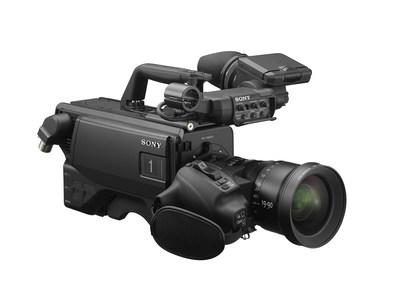
"There is a strong desire to integrate the 'cinematic look' into sports and entertainment productions to heighten emotions and enable more connected storytelling," said Theresa Alesso, Pro Division President, Sony Electronics. "Listening to the voice of our customers, we've taken our expertise with 35mm cinema cameras and our learnings in industry-leading system cameras and created a new Super 35mm system camera that will match perfectly and easily work alongside our HDC camera series, as well as our portfolio of production solutions."
A first for a systemized S35mm system, the HDC-F5500 features a motorized 8-step ND filter adopted in Sony's digital motion picture camera VENICE, which can be controlled locally or remotely, for increased operational flexibility. It also allows for the precise selection of focus depth as well as controlled capture of fast-moving subjects even in bright lighting conditions. Another highlight of the new system camera is its wide color gamut. Support for BT.2020, S-Gamut3/S-Gamut3.cine and HLG enhance creativity and reality and match seamlessly with the color science driving Sony's most in-demand cameras.
The new camera also provides numerous workflow enhancements for more efficient live production. The HDC-F5500 integrates with Sony's IP Live production system through the use of the HDCU-5000 series, which supports SMPTE ST 2110 and AMWA NMOS standards. The HDC-F5500 can utilize the new IP extension adaptor HDCE-TX50 for remote production or multi-camera flight pack "CCU-Less" operation. The HDC-F5500 is also compatible with Sony's existing SR Live for HDR workflow with HLG and S-Log3.
Additionally, the newly developed ARIA (Automatic Restoration of Illumination Attenuation) function, for select supported PL and zoom lenses, calibrates and compensates picture appearance when shooting at a distance.
Other features include a new viewfinder slide mechanism compatible with existing large viewfinders that minimizes the camera operator's body movement while panning and allows for use in tight or challenging environments. The HDC-F5500 also has an ergonomic grip for handheld work, and side tally lamp. 4K/12G-SDI direct output from the camera facilitates wireless operation and direct recording.
The HDC-F5500 is planned to be available in December 2021. For more information about this new system camera or Sony's lineup of HDC cameras, please visit pro.sony.
About Sony Electronics Inc.
Sony Electronics is a subsidiary of Sony Corporation of America and an affiliate of Sony Group Corporation, one of the most comprehensive entertainment companies in the world, with a portfolio that encompasses electronics, music, motion pictures, mobile, gaming, robotics and financial services. Headquartered in San Diego, California, Sony Electronics is a leader in electronics for the consumer and professional markets. Operations include research and development, engineering, sales, marketing, distribution and customer service. Sony Electronics creates products that innovate and inspire generations, such as the award-winning Alpha Interchangeable Lens Cameras and revolutionary high-resolution audio products. Sony is also a leading manufacturer of end-to-end solutions from 4K professional broadcast and A/V equipment to industry leading 4K and 8K Ultra HD TVs. Visit http://www.sony.com/news for more information.

SOURCE Sony Electronics, Inc.
PARAMUS, N.J., Oct. 12, 2021 /PRNewswire/ -- Sony today announced the HDC-F5500 system camera, the latest entry in Sony's HDC camera series, which boasts a highly sensitive Super 35mm, 4K CMOS global shutter image sensor that enables shallow depth of field. The new multi-format addition builds on the success and benefits of the industry-standard HDC lineup and serves as a powerful tool for those in need of creative expression with a cinematic look, in a system camera form factor and workflow. Thanks to the global shutter effect to prevent rolling shutter distortion and flash band, and its high frame rate capability of 120fps, the HDC-F5500 is ideal for sports and live entertainment production. The camera's high sensitivity and low noise also make it suitable for capturing dark scenes, which is especially beneficial for drama productions.
"There is a strong desire to integrate the 'cinematic look' into sports and entertainment productions to heighten emotions and enable more connected storytelling," said Theresa Alesso, Pro Division President, Sony Electronics. "Listening to the voice of our customers, we've taken our expertise with 35mm cinema cameras and our learnings in industry-leading system cameras and created a new Super 35mm system camera that will match perfectly and easily work alongside our HDC camera series, as well as our portfolio of production solutions."
A first for a systemized S35mm system, the HDC-F5500 features a motorized 8-step ND filter adopted in Sony's digital motion picture camera VENICE, which can be controlled locally or remotely, for increased operational flexibility. It also allows for the precise selection of focus depth as well as controlled capture of fast-moving subjects even in bright lighting conditions. Another highlight of the new system camera is its wide color gamut. Support for BT.2020, S-Gamut3/S-Gamut3.cine and HLG enhance creativity and reality and match seamlessly with the color science driving Sony's most in-demand cameras.
The new camera also provides numerous workflow enhancements for more efficient live production. The HDC-F5500 integrates with Sony's IP Live production system through the use of the HDCU-5000 series, which supports SMPTE ST 2110 and AMWA NMOS standards. The HDC-F5500 can utilize the new IP extension adaptor HDCE-TX50 for remote production or multi-camera flight pack "CCU-Less" operation. The HDC-F5500 is also compatible with Sony's existing SR Live for HDR workflow with HLG and S-Log3.
Additionally, the newly developed ARIA (Automatic Restoration of Illumination Attenuation) function, for select supported PL and zoom lenses, calibrates and compensates picture appearance when shooting at a distance.
Other features include a new viewfinder slide mechanism compatible with existing large viewfinders that minimizes the camera operator's body movement while panning and allows for use in tight or challenging environments. The HDC-F5500 also has an ergonomic grip for handheld work, and side tally lamp. 4K/12G-SDI direct output from the camera facilitates wireless operation and direct recording.
The HDC-F5500 is planned to be available in December 2021. For more information about this new system camera or Sony's lineup of HDC cameras, please visit pro.sony.
About Sony Electronics Inc.
Sony Electronics is a subsidiary of Sony Corporation of America and an affiliate of Sony Group Corporation, one of the most comprehensive entertainment companies in the world, with a portfolio that encompasses electronics, music, motion pictures, mobile, gaming, robotics and financial services. Headquartered in San Diego, California, Sony Electronics is a leader in electronics for the consumer and professional markets. Operations include research and development, engineering, sales, marketing, distribution and customer service. Sony Electronics creates products that innovate and inspire generations, such as the award-winning Alpha Interchangeable Lens Cameras and revolutionary high-resolution audio products. Sony is also a leading manufacturer of end-to-end solutions from 4K professional broadcast and A/V equipment to industry leading 4K and 8K Ultra HD TVs. Visit http://www.sony.com/news for more information.
SOURCE Sony Electronics, Inc.
SAN DIEGO, Oct. 13, 2021 /PRNewswire/ -- Sony Electronics Inc. announced the newest lens in their G Master lineup – the FE 70-200mm F2.8 GM OSS II, which delivers an extraordinary combination of resolution and bokeh as well as unequalled AF (autofocus) performance known to Sony's G Master design.

"Sony is always listening to our customers. Thanks to feedback from users around the world, including leading professionals, Sony continues to develop and evolve the G Master lineup," said Yang Cheng, Vice President, Imaging Solutions, Sony Electronics Inc. "The FE 70-200mm F2.8 GM OSS II is lightweight and offers outstanding handling in any shooting situation. The newest addition to our G Master series will make a perfect telephoto zoom addition to any creator's kit who is looking to maximize their gear potential for both stills and video."
Designed to perfectly pair with Sony's E-mount camera bodies, the FE 70-200mm F2.8 GM OSS II not only offers outstanding optical quality and advanced AF performance, but it is the lightesti F2.8 70-200mm zoom in the world and allows for unprecedented shooting freedom and flexibility. Sony continues to strengthen the Alpha system with this newest addition to the broadest selection of mirrorless lenses on the market as the 65th lens in its E-mount lens lineup.
New Levels of Performance
The new FE 70-200mm F2.8 GM OSS II delivers outstanding image quality with high resolution and clarity. Users can expect a clean and clear image from corner to corner throughout the entire zoom range, even when the aperture is wide open. Thanks to the two aspherical lens elements, including one XA (extreme aspherical) element manufactured to 0.01-micron surface precision, the FE 70-200mm F2.8 GM OSS II effectively controls distance-related aberration variations to ensure outstanding resolution throughout the image area.
The FE 70-200mm F2.8 GM OSS II also employs two ED (extra-low dispersion) spherical glass elements and two Super ED spherical glass elements to significantly reduce chromatic aberration without color bleeding. This lens also includes an ED aspherical element for the first time in an Alpha system lens, which simultaneously suppresses chromatic and spherical aberration, common issues in other telephoto lenses.
Smooth, beautiful bokeh is made possible by a large F2.8 maximum aperture and a newly developed 11-blade circular aperture unit. In addition, the lens' advanced optical design including an XA element thoroughly suppresses the unwanted 'onion ring' effect, further enhancing the bokeh. The FE 70-200mm F2.8 GM OSS II also offers excellent close-up performance with deep bokeh. The minimum focusing distance is just 15.7 inches (0.4 meters) at 70mm and 32.3 inches (0.82 meters) at 200mm, with a maximum magnification of 0.3x. Moreover, the FE 70-200mm F2.8 GM OSS II can be easily paired with Sony's high-performance 1.4x or 2.0x teleconverteriii to extend the lens' focal length to 400mmiv at an F5.6 aperture, all while maintaining its G Master quality.
To avoid any unwanted flare and ghosting in challenging lighting conditions, Sony's original Nano AR Coating II produces a uniform anti-reflection coating on the surface of the lens. In addition, the FE 70-200mm F2.8 GM OSS II's optical design also effectively suppresses internal reflections to improve clarity.
Industry-leading Autofocus
The FE 70-200mm F2.8 GM OSS II's state-of-the-art lens technology brings out the best in the advanced camera body it is paired with. The new lens uses four Sony-original XD (extreme dynamic) Linear Motors for extraordinary fast and precise AF, making it up to approximately four times fasterii and with focus tracking improved by 30% when compared to the previous modelii. When paired with Sony's flagship Alpha 1, the FE 70-200mm F2.8 GM OSS II is capable of high-speed continuous shooting at up to 30 fpsv. Superb AF tracking is also available even when using a teleconverter. For video, the FE 70-200mm F2.8 GM OSS II offers smooth and quiet AF to reliably lock in focus and track fast-moving subjects, even while zooming, so the user can leave the focusing to the camera.
Advanced Features for Video
With its constant F2.8 maximum aperture, astounding AF performance, versatile control, and solid reliability, the FE 70-200mm F2.8 GM OSS II is a perfect choice for video. The new lens was designed to dramatically reduce focus breathing, focus shift, and axis shift when zooming so that there is minimal unwanted image movement and angle of view variations.
For easy video-use operation, the FE 70-200mm F2.8 GM OSS II features independent control rings for focus, zoom, and aperture (iris), allowing precise manual operation. The aperture ring also has a click ON/OFF switch. Additionally, Sony's Linear Response MF ensures responsive, low-lag manual focus control. The supplied lens hood also features an opening that allows convenient operation of circular polarizing filters or variable ND filters for more creative flexibility.
Designed for Professionals
The FE 70-200mm F2.8 GM OSS II is the world's lightesti F2.8 telephoto zoom lens and is approximately 29% lighter than the previous model, weighing just under 37 oz (1,045g). In addition to its light weight, the FE 70-200mm F2.8 GM OSS II was designed for professionals to offer an ideal balance without front-heaviness, ensuring that the lens' center of gravity falls directly above the tripod mount. It also features internal zoom to keep the center of gravity constant.
The FE 70-200mm F2.8 GM OSS II has been specifically designed for professionals based on their direct feedback. The new lens includes focus functions to support the user's professional needs such as Full-time DMF, natural and linear manual focus response, and a focus-range limiter switch. The FE 70-200mm F2.8 GM OSS II also includes three customizable focus hold buttons that are provided 90° apart for easy access and convenient control when shooting in horizontal or vertical orientation, and nearly any angle.
The FE 70-200mm F2.8 GM OSS II features both a click ON/OFF switch and an iris lock switch for quick, flexible aperture control. The aperture ring click stops can be turned ON to provide tactile feedback when shooting stills, or OFF for smooth, silent aperture control when shooting movies. In addition, the zoom ring torque is optimized and now includes image stabilization with MODE 3vi for moving subjects.
Based on feedback from professionals, the FE 70-200mm F2.8 GM OSS II is designed to be reliable in even the most challenging environments. It features dust and moisture resistancevii, equal to the FE 400mm F2.8 GM OSS and FE 600mm F4 GM OSS. The front lens element features a fluorine coating that repels water, oil, and other contaminants, while making it easier to wipe off any contaminants or fingerprints that may become attached to the lens surface.
Pricing and Availability
The new FE 70-200mm F2.8 GM OSS II will be available in December for approximately $2,800.00 USD and $3,500.00 CAD. It will be sold at a variety of Sony's authorized dealers throughout North America.
Exclusive stories and exciting new content shot with the new FE 70-200mm F2.8 GM OSS II and Sony's other imaging products can be found at www.alphauniverse.com, a site created to educate and inspire all fans and customers of Sony α - Alpha brand.
New content will also be posted directly at the Sony Photo Gallery. For detailed product information, please visit:
A product video on the new FE 70-200mm F2.8 GM OSS II can be viewed HERE.
About Sony Electronics Inc.
Sony Electronics is a subsidiary of Sony Corporation of America and an affiliate of Sony Group Corporation, one of the most comprehensive entertainment companies in the world, with a portfolio that encompasses electronics, music, motion pictures, mobile, gaming, robotics and financial services. Headquartered in San Diego, California, Sony Electronics is a leader in electronics for the consumer and professional markets. Operations include research and development, engineering, sales, marketing, distribution and customer service. Sony Electronics creates products that innovate and inspire generations, such as the award-winning Alpha Interchangeable Lens Cameras and revolutionary high-resolution audio products. Sony is also a leading manufacturer of end-to-end solutions from 4K professional broadcast and A/V equipment to industry leading 4K and 8K Ultra HD TVs. Visit http://www.sony.com/news for more information.
Notes:
|
i As of the October 2021 product announcement, compared to full-frame F2.8 70-200mm telephoto zoom lenses that support autofocus. Sony survey. |
||
|
ii When attached to the Alpha 1, compared to SEL70200GM. Sony test conditions. |
||
|
iii Maximum aperture with the 1.4x and 2.0x teleconverters is F4 and F5.6, respectively. |
||
|
iv 2.0x teleconverter can realize 400mm focal length. 1.4x teleconverter can realize 280mm focal length. |
||
|
v Sony test conditions. |
||
|
vi A software update may be required. See Sony's support page on the web for camera compatibility info. |
||
|
vii Not guaranteed to be 100% dust and moisture proof. |
||
SAN DIEGO, Oct. 21, 2021 /PRNewswire/ -- Sony Electronics Inc. today announced three new additions to its imaging line-up: the Alpha 7 IV interchangeable-lens camera (model ILCE-7M4) with a newly developed 33-megapixel (approx., effective) full-frame image sensor, as well as two new flashes – the HVL-F60RM2 and HVL-F46RM.

The Alpha 7 IV takes "basic" to the next level for full-frame cameras with excellent image quality and performance, redefining the lofty standards set by the acclaimed Alpha 7 III. The new model features many of Sony's most advanced imaging technologies, including the latest BIONZ XR™ processing engine and advanced AF (autofocus) capabilities from the flagship Alpha 1 combined with streamlined operability and enhanced reliability for photos and movies, making it the perfect all-around camera for today's imaging enthusiasts and professionals. The Alpha 7 IV also boasts a 33MP (approx., effective) image resolution, rich movie expression and various features to support the growing demand for remote communication, bringing new meaning to what a "basic" camera can accomplish.
"Since its introduction over three years ago, the Alpha 7 III has made tremendous impact in our industry, completely redefining the expectations for what can be accomplished with a 'basic', or entry-level full-frame camera," said Yang Cheng, Vice President, Imaging Solutions, Sony Electronics Inc. "Now, it's time to break through all existing boundaries again. The Alpha 7 IV brings together the best of Sony imaging technologies in both photo and video to deliver a high-end experience to a wider range of customers. This gives today's creators a new level of freedom to capture, create and share in ways that they've never been able to before, no matter the situation in which they find themselves."
Alpha 7 IV: Innovation Never Ends
The new Alpha 7 IV is an exceptional hybrid camera packed with outstanding still image quality and evolved video technology with advanced autofocus, enhanced operability and improved workflow capability. The model was developed with the environment in mind by using Sony's original recycled plastic SORPLAS™ for the camera body and packaging with recyclablei materials and less plastic.
Outstanding Image Quality
Thanks to a newly developed 33MP (approx., effective) full-frame back-illuminated Exmor R™ CMOS image sensor, superior image quality and Wide ISO sensitivity range expandable to ISO 50 - 204,800 is achieved. The high resolution enables the Alpha 7 IV to express smooth gradation, fine details and textures of the subject while reducing noise, and its 15-stop dynamic range allows a wide expressive range while Creative Look settings can help create original looks effortlessly for both stills and video.
Next-Level AF performance
The latest BIONZ XR™ processing engine is the same that is used in Sony's flagship Alpha 1, delivering high-speed AF, uninterrupted continuous shooting up to 10fpsii with AF/AE tracking and a large buffer for a prolonged shooting experience. The Alpha 7 IV tracks subjects with tenacious Real-time Tracking and 759 phase-detection AF points in a high-density focal plane phase-detection AF system that covers approximately 94% of the image area. Additionally, for the first time, Real-time Eye AF can now track birds' and animals' eye for both still images and movies, in addition to humans. The Alpha 7 IV also has face and eye detection accuracy for humans that is improved by approximately 30% compared to the Alpha 7 III.
Evolved Movie Technology
The Alpha 7 IV inherits technology taken from real-world movie production, including the S-Cinetone™ picture profile adopted from Sony's highly regarded Cinema Line cameras. This delivers a rich, cinematic look that has become popularized by a broad range of cinematographers and filmmakers who are shooting on Sony. High quality movie is achieved with 4K 60p recording in Super 35mm mode and up to 4K 30p recording with 7K oversampling is available in full-frame mode. The new camera also features 10-bit depth 4:2:2 color sampling to enable natural gradation, XAVC S-I™ intra-frame encoding for more efficient editing workflows and XAVC HS™ H.265 long-GOP for doubled compression efficiency.
To meet the growing need for precise autofocus performance when shooting videos, unique AF features are achieved when using the Alpha 7 IV with a Sony E-mount lens, including AF Assistiii that supports focus transitions when using AF, and Focus Map that visualizes depth of field. For the first time in the Alpha series, the new camera features Breathing Compensationiv to combat focus breathing and maintain a consistent angle of view throughout focus changes and can be switched on or off.
Advanced Operability as a Genuine Hybrid Model
The Alpha 7 IV is a hybrid still and video camera with outstanding operability and reliability that easily allows the user to switch from photo to video and back at their convenience. New to Sony's lineup of Alpha cameras is a dual-layer mode dial, with a lower layer for selecting Still/Movie/S&Q and a top layer for Auto/P/A/S/M and MR (Memory Recall), enabling users to quickly select and switch between the dedicated settings. It also has 5-axis optical in-body image stabilization for a 5.5-stepv shutter speed advantage, an improved grip for greater comfort, and a CFexpress Type A compatible media slot to support media with faster writing and clearance. Additionally, the 3.68 million-dot (approx.) OLED Quad-VGA viewfinder is 1.6 times the resolution of the Alpha 7 III viewfinder, benefiting users with an upgraded live-view image quality that minimizes false color and increases resolution.
Videographers can record 4K 60p 10-bit 4:2:2 video continuously for more than an hour thanks to the camera's heat-dissipating structure. Optical 'Active Mode'vi image stabilization further stabilizes movie shooting. They can also benefit from the 3-inch (3.0-type) 1.03 million-dot (approx.) side-opening vari-angle touch-panel rear LCD monitor, top-panel REC button and high-capacity Z-series battery.
The Alpha 7 IV body is built with magnesium alloy to achieve a robustness while minimizing its weight. In addition, the redesigned structure and lens lock button contribute to enhanced dust and moisture resistancevii.
Enhanced Workflow Capabilities
By offering a variety of connectivity options, the Alpha 7 IV enables on-the-spot streaming and sharing of high-quality content to meet the growing need for remote communication in real-time without sacrificing excellent image and sound quality. The connection between the camera and Imaging Edge Mobile™ applicationviii is simplified via Bluetooth, and fast data transfer is possible by 5GHz/2.4.GHz Wi-Fi.
The camera also has a new feature called "Shot Mark" to enable easy access to the marked scenes in a video clip, within camera and on Sony's Catalyst Browse/Prepare applications.ix
Moreover, the camera has a range of new features to support live streaming and remote communication without needing dedicated software. UVC (USB Video Class) and UAC (USB Audio Class) turn the Alpha 7 IV into a high-performance live streaming camera when connected to a computer or smartphonex. High image quality such as 4K 15p and 1080 FHD 60p deliver realistic video for remote sharing and the Alpha 7 IV's digital audio interface can be paired with a range of mics and accessories to deliver high quality sound.
Finally, Sony plans to offer a new cloud service next year, "AI Video Editing Studio", for automated editing with AI technology. To allow creators to focus on more creative tasks, "AI Video Editing Studio" automatically performs initial editing in the cloud, using AI technology. Sony will continue to strive to offer a wide variety of imaging experiences and services through the active integration and advancement of cameras, cloud and AI.
Designed with the Environment in Mind
In line with Sony's environmental efforts based on the "Road to Zero" initiative, environment was an important factor in the development of the Alpha 7 IV's design, production and packaging. The camera uses recycled plastic, SORPLAS™, which does not depend on non-renewable resources and is produced at the sites by using renewable energy such as solar power generation. The product packaging also adopts recyclable plastic-reduced materials.
HVL-F60RM2 and HVL-F46RM: Powerful Flashes to Evolve Alpha Lighting System
The HVL-F60RM2 with GN 60 and 20-200mm[xi] coverage and HVL-F46RM with GN 46 and 24-105mmxi are powerful wireless flashes to offer precise control, enhanced high-speed and intuitive operability. They are designed to meet the needs of both professional and advanced content creators when shooting with a Sony Alpha camera, including the Alpha 7 IV, to offer the ultimate Alpha Lighting System by the detailed communication between cameras and external flash.
Both flashes have upgraded continuous shooting flash performance, up to 200 consecutive flashes at 10 frames per secondxii for the HVL-F60RM2 and 60 times for the HVL-F46RM. The optimized flash algorithm ensures both flashes are overheat-resistant, and a set of four Ni-MH (Nickel-metal hydride) batteries can power up to 240 flashes with a 1.7 second recycle time for the HVL-F60RM2 and up to 320 flashes with a 2.0 second recycle time for the HVL-F46RMxiii.
When used in combination with an Alpha camera, they allow users to experience the unique communication and system benefits of the Alpha Lighting System that sets a new standard for mirrorless camera lighting systems. For example, with the Alpha 7 IV, P-TTL flash control metering for every frame in Mid, and Hi continuous mode has become possible in addition to Lo continuous mode. The flash release time lag is also shortened to capture momentary facial expressions and movements of the subject.
With the Alpha 1, the HVL-F60RM2 achieves a phenomenal up to 20fps of continuous shootingxiv and approximately 20 flashes per second can be produced for more than 10 seconds with the external flash battery adapter FA-EBA1 (sold separately). When the Alpha 1 is used with Sony's flashes, including HVL-F60RM2 and HVL-F46RM, users can sync up to 1/400 second shutter speed to expand expressive capabilities when shooting in full-frame mode. In addition, with the silent electronic shutter of the camera, silent flash shooting is possible when absolute silence is required.
Other system benefits of HVL-F60RM2 and HVL-F46RM with an Alpha camera include:
Both flashes also feature improved robustness and operability. The Multi Interface shoe with Sony's unique metal shoe foot with rugged side frame significantly increases strength and reliability. Shoe sealing helps the flashes to be more dust and moisture resistantxvi. The HVL-F60RM2's original rotating head mechanism, "Quick Shift Bounce," that enables flexible positioning and optimum lighting control has also been improved to prevent unintended change in the bounce angle.
They support wireless radio communication and can control up to 15 flashes and/or receiver units in 5 groups via wireless radio communication for enhanced lighting control versatility.
Visual Story is now Supported on Android
"Visual Story" is a mobile application for professional event photographers and video creators to enable immediate and automatic delivery of photos and moviesxvii to their clients after an event through gallery creation, utilize AI (artificial intelligence) assistance for easy image selection, upload assets online and more. While the Visual Story app is already available to iOS users, Android user can now also take advantage of the benefits Visual Story provides to professional photographers and videographers.
When using the Alpha 7 IV, "Shot Mark" is also supported by Visual Story on iOS Version 2.1.
Pricing and Availability
The new Alpha 7 IV will be available in December 2021 for approximately $2,500.00 USD and $3,200.00 CAD. It will be sold at a variety of Sony's authorized dealers throughout North America. The PCK-LG2 Screen Protect Glass Sheet accessory for the Alpha 7 IV will be available at the same time.
A kit version with Sony's FE 28-70mm F3.5-5.6 OSS zoom lens will also be available for approximately $2,700.00 USD and $3,400.00 CAD.
The new HVL-F46RM will be available in November 2021 for approximately $400.00 USD and $550.00 CAD. It will be sold at a variety of Sony's authorized dealers throughout North America.
The new HVL-F60RM2 will be available in November 2021 for approximately $550.00 USD and $750.00 CAD. It will be sold at a variety of Sony's authorized dealers throughout North America.
Exclusive stories and exciting new content shot with the new Alpha 7 IV and Sony's other imaging products can be found at www.alphauniverse.com, a site created to educate and inspire all fans and customers of Sony α - Alpha brand.
New content will also be posted directly at the Sony Photo Gallery. For detailed product information, please visit:
A product video on the new Alpha 7 IV can be viewed HERE.
About Sony Electronics Inc.
Sony Electronics is a subsidiary of Sony Corporation of America and an affiliate of Sony Group Corporation, one of the most comprehensive entertainment companies in the world, with a portfolio that encompasses electronics, music, motion pictures, mobile, gaming, robotics and financial services. Headquartered in San Diego, California, Sony Electronics is a leader in electronics for the consumer and professional markets. Operations include research and development, engineering, sales, marketing, distribution and customer service. Sony Electronics creates products that innovate and inspire generations, such as the award-winning Alpha Interchangeable Lens Cameras and revolutionary high-resolution audio products. Sony is also a leading manufacturer of end-to-end solutions from 4K professional broadcast and A/V equipment to industry leading 4K and 8K Ultra HD TVs. Visit http://www.sony.com/news for more information.
Notes:
i This product packaging is recyclable only in the communities that have appropriate recycling programs.
ii Up to 10 fps in continuous "Hi+" mode, or up to 8 fps in continuous "Hi" mode. Continuous shooting speed may vary depending on shooting conditions. Sony tests.
iii Not available when using the SELP1650, SEL18200LE or A-mount lenses.
iv Angle of view and image quality may change slightly when this feature is turned ON. Breathing compensation is not available for unsupported lenses, 120/100p movie recording, S&Q recording at 120/100p, or stills. For the supported lens, please check here.
v CIPA standards. Pitch/yaw shake only. Planar T* FE 50mm F1.4 ZA lens. Long exposure NR off. Still-image mode.
vi Slight image crop in Active Mode. "Standard" setting recommended for focal lengths of 200mm or longer. Active mode not available when recording at 120 (100) fps.
vii Not guaranteed to be 100% dust and moisture proof.
viii Version 7.6 (to be released soon) or a later version. Download Imaging Edge app at Google Play and the App Store. Network services, content, and operating system and software subject to terms and conditions and may be changed, interrupted, or discontinued at any time and may require fees, registration and credit card information. Membership to Imaging Edge account and app on smartphone required with connection to Wi-Fi. See Imaging Edge terms and conditions/privacy policy for details.
ix Supported in Catalyst version 2021.1 or later.
x PC or smartphone OS must be compatible with UVC/UAC to use this functionality. Compatibility with PC and smartphones depends on manufacturers' specifications. A commercially available USB cable and/or terminal adaptor may be used to connect to equipment with a USB Type-C port.
xi 35mm full-frame equivalent.
xii 1/32 flash output level using Ni-MH batteries
xiii When using Ni-MH batteries. Sony tests
xiv Alpha 1 electronic shutter in continuous Hi+ mode. Flash output level manually set to 1/32.
xv Visit Sony support webpage for functional compatibility information.
xvi Not guaranteed to be 100% dust and moisture proof. Dust and moisture resistance will vary also according to the body to which the unit is attached.
xvii Video delivery is only supported on iOS. Download app at Google Play and the App Store. Network services, content, and operating system and software subject to terms and conditions and may be changed, interrupted, or discontinued at any time and may require fees, registration and credit card information.

SOURCE Sony Electronics, Inc.

Ya sea que necesite actualizar manualmente el software de su REDMAGIC o actualizar su dispositivo con la ROM global, siga las instrucciones a continuación.
NOTAS:
We really took a pounding.
#1: Cael's High School Beating
#2: Sam's High School Beating
#3: Karl's High School Beating
Imagine, for a second, you relied on a standard office printer to print out weekly reports. Nowadays, even your run-of-the-mill printer has countless fancy features. And yet, come Friday, you shuffle over to the printer and push, by sheer force of habit, the same buttons in the same sequence to get the same result. Naturally, your report is never formatted exactly how you wanted (perhaps the margins are too narrow or the images are too dark), so you just accept the result because it would be too time-consuming to figure out how to get the thing to do exactly what you want it to. Nobody likes doing this type of tedious work, which is why it usually got passed off on me back when I was an intern: “Hey Hector, can you print this out for me, same as last week but just skip the images?” I couldn’t delegate this to somebody else, because the only thing lower in the hierarchy than me was, well, the printer. 🖨
But imagine how enjoyable my internship would’ve been if I could’ve talked to my printer. Nowadays, some smart printers can already handle basic voice commands, eliminating some of the inefficient button pushing. But what if these smart printers could take it a step further and carry on a context-sensitive conversation that accounts for changing needs? It might, for instance, make helpful suggestions like, “It looks like you’re just printing a quick draft, so should I make it black and white to save some ink?” This would make it more than just a useful tool, but an assistive agent. 💥
alkfjalk akfji on your home is good woud
akfdla;lfkl
alkjfa;lsdfk
afjalsjfl;
When I moved from Mexico to the US, I had difficulties expressing myself in English. And because personal expression is so important to me, I had a lot of frustrating experiences where I longed to use the Spanish words I felt more comfortable with. But I also knew that I wanted to make a life here; I knew that this language was to be my new medium of communication. So I was patient with myself and, thankfully, so too were my new friends and colleagues. 🇲🇽🇺🇸
We’ll all have to be patient with this new conversational technology. We still have a lot of work to do to improve natural language understanding and speech technology. In the meantime, you’re bound to have a few frustrating interactions where, like me in my first years here in the US, you long for your accustomed medium. But deep down, you know the world is changing and many of these interaction models are becoming obsolete. 🌎
We should just be grateful that we don’t need to learn a new language to interact with this new technology. We just need to get used to speaking it with somebody — or better yet, something — that is still learning to talk. So be patient, be open-minded, and just be yourself. Only then will the future of technology finally take a human shape.This might be the end of the article, but hopefully the beginning of a longer conversation. I’m eager to expand my thinking in this space and would love to hear your perspectives. 🎆
Fore more about this conversation, here’s my latest talk @ CX SF 2019 🕺🏽and podcast at Forrester What It Means series (The Ambiguity-Laden March Toward People-Centric Design). 👋🏽
Illustrations by Helen Slavutsky
When I moved from Mexico to the US, I had difficulties expressing myself in English. And because personal expression is so important to me, I had a lot of frustrating experiences where I longed to use the Spanish words I felt more comfortable with. But I also knew that I wanted to make a life here; I knew that this language was to be my new medium of communication. So I was patient with myself and, thankfully, so too were my new friends and colleagues. 🇲🇽🇺🇸
We’ll all have to be patient with this new conversational technology. We still have a lot of work to do to improve natural language understanding and speech technology. In the meantime, you’re bound to have a few frustrating interactions where, like me in my first years here in the US, you long for your accustomed medium. But deep down, you know the world is changing and many of these interaction models are becoming obsolete. 🌎
We should just be grateful that we don’t need to learn a new language to interact with this new technology. We just need to get used to speaking it with somebody — or better yet, something — that is still learning to talk. So be patient, be open-minded, and just be yourself. Only then will the future of technology finally take a human shape.This might be the end of the article, but hopefully the beginning of a longer conversation. I’m eager to expand my thinking in this space and would love to hear your perspectives. 🎆
Fore more about this conversation, here’s my latest talk @ CX SF 2019 🕺🏽and podcast at Forrester What It Means series (The Ambiguity-Laden March Toward People-Centric Design). 👋🏽
Illustrations by Helen Slavutsky
When I moved from Mexico to the US, I had difficulties expressing myself in English. And because personal expression is so important to me, I had a lot of frustrating experiences where I longed to use the Spanish words I felt more comfortable with. But I also knew that I wanted to make a life here; I knew that this language was to be my new medium of communication. So I was patient with myself and, thankfully, so too were my new friends and colleagues. 🇲🇽🇺🇸
We’ll all have to be patient with this new conversational technology. We still have a lot of work to do to improve natural language understanding and speech technology. In the meantime, you’re bound to have a few frustrating interactions where, like me in my first years here in the US, you long for your accustomed medium. But deep down, you know the world is changing and many of these interaction models are becoming obsolete. 🌎
We should just be grateful that we don’t need to learn a new language to interact with this new technology. We just need to get used to speaking it with somebody — or better yet, something — that is still learning to talk. So be patient, be open-minded, and just be yourself. Only then will the future of technology finally take a human shape.This might be the end of the article, but hopefully the beginning of a longer conversation. I’m eager to expand my thinking in this space and would love to hear your perspectives. 🎆
Fore more about this conversation, here’s my latest talk @ CX SF 2019 🕺🏽and podcast at Forrester What It Means series (The Ambiguity-Laden March Toward People-Centric Design). 👋🏽
Illustrations by Helen Slavutsky
When I moved from Mexico to the US, I had difficulties expressing myself in English. And because personal expression is so important to me, I had a lot of frustrating experiences where I longed to use the Spanish words I felt more comfortable with. But I also knew that I wanted to make a life here; I knew that this language was to be my new medium of communication. So I was patient with myself and, thankfully, so too were my new friends and colleagues. 🇲🇽🇺🇸
We’ll all have to be patient with this new conversational technology. We still have a lot of work to do to improve natural language understanding and speech technology. In the meantime, you’re bound to have a few frustrating interactions where, like me in my first years here in the US, you long for your accustomed medium. But deep down, you know the world is changing and many of these interaction models are becoming obsolete. 🌎
We should just be grateful that we don’t need to learn a new language to interact with this new technology. We just need to get used to speaking it with somebody — or better yet, something — that is still learning to talk. So be patient, be open-minded, and just be yourself. Only then will the future of technology finally take a human shape.This might be the end of the article, but hopefully the beginning of a longer conversation. I’m eager to expand my thinking in this space and would love to hear your perspectives. 🎆
Fore more about this conversation, here’s my latest talk @ CX SF 2019 🕺🏽and podcast at Forrester What It Means series (The Ambiguity-Laden March Toward People-Centric Design). 👋🏽
Illustrations by Helen Slavutsky
When I moved from Mexico to the US, I had difficulties expressing myself in English. And because personal expression is so important to me, I had a lot of frustrating experiences where I longed to use the Spanish words I felt more comfortable with. But I also knew that I wanted to make a life here; I knew that this language was to be my new medium of communication. So I was patient with myself and, thankfully, so too were my new friends and colleagues. 🇲🇽🇺🇸
We’ll all have to be patient with this new conversational technology. We still have a lot of work to do to improve natural language understanding and speech technology. In the meantime, you’re bound to have a few frustrating interactions where, like me in my first years here in the US, you long for your accustomed medium. But deep down, you know the world is changing and many of these interaction models are becoming obsolete. 🌎
We should just be grateful that we don’t need to learn a new language to interact with this new technology. We just need to get used to speaking it with somebody — or better yet, something — that is still learning to talk. So be patient, be open-minded, and just be yourself. Only then will the future of technology finally take a human shape.This might be the end of the article, but hopefully the beginning of a longer conversation. I’m eager to expand my thinking in this space and would love to hear your perspectives. 🎆
Fore more about this conversation, here’s my latest talk @ CX SF 2019 🕺🏽and podcast at Forrester What It Means series (The Ambiguity-Laden March Toward People-Centric Design). 👋🏽
Illustrations by Helen Slavutsky
When I moved from Mexico to the US, I had difficulties expressing myself in English. And because personal expression is so important to me, I had a lot of frustrating experiences where I longed to use the Spanish words I felt more comfortable with. But I also knew that I wanted to make a life here; I knew that this language was to be my new medium of communication. So I was patient with myself and, thankfully, so too were my new friends and colleagues. 🇲🇽🇺🇸
We’ll all have to be patient with this new conversational technology. We still have a lot of work to do to improve natural language understanding and speech technology. In the meantime, you’re bound to have a few frustrating interactions where, like me in my first years here in the US, you long for your accustomed medium. But deep down, you know the world is changing and many of these interaction models are becoming obsolete. 🌎
We should just be grateful that we don’t need to learn a new language to interact with this new technology. We just need to get used to speaking it with somebody — or better yet, something — that is still learning to talk. So be patient, be open-minded, and just be yourself. Only then will the future of technology finally take a human shape.This might be the end of the article, but hopefully the beginning of a longer conversation. I’m eager to expand my thinking in this space and would love to hear your perspectives. 🎆
Fore more about this conversation, here’s my latest talk @ CX SF 2019 🕺🏽and podcast at Forrester What It Means series (The Ambiguity-Laden March Toward People-Centric Design). 👋🏽
Illustrations by Helen Slavutsky
When I moved from Mexico to the US, I had difficulties expressing myself in English. And because personal expression is so important to me, I had a lot of frustrating experiences where I longed to use the Spanish words I felt more comfortable with. But I also knew that I wanted to make a life here; I knew that this language was to be my new medium of communication. So I was patient with myself and, thankfully, so too were my new friends and colleagues. 🇲🇽🇺🇸
We’ll all have to be patient with this new conversational technology. We still have a lot of work to do to improve natural language understanding and speech technology. In the meantime, you’re bound to have a few frustrating interactions where, like me in my first years here in the US, you long for your accustomed medium. But deep down, you know the world is changing and many of these interaction models are becoming obsolete. 🌎
We should just be grateful that we don’t need to learn a new language to interact with this new technology. We just need to get used to speaking it with somebody — or better yet, something — that is still learning to talk. So be patient, be open-minded, and just be yourself. Only then will the future of technology finally take a human shape.This might be the end of the article, but hopefully the beginning of a longer conversation. I’m eager to expand my thinking in this space and would love to hear your perspectives. 🎆
Fore more about this conversation, here’s my latest talk @ CX SF 2019 🕺🏽and podcast at Forrester What It Means series (The Ambiguity-Laden March Toward People-Centric Design). 👋🏽
Illustrations by Helen Slavutsky
When I moved from Mexico to the US, I had difficulties expressing myself in English. And because personal expression is so important to me, I had a lot of frustrating experiences where I longed to use the Spanish words I felt more comfortable with. But I also knew that I wanted to make a life here; I knew that this language was to be my new medium of communication. So I was patient with myself and, thankfully, so too were my new friends and colleagues. 🇲🇽🇺🇸
We’ll all have to be patient with this new conversational technology. We still have a lot of work to do to improve natural language understanding and speech technology. In the meantime, you’re bound to have a few frustrating interactions where, like me in my first years here in the US, you long for your accustomed medium. But deep down, you know the world is changing and many of these interaction models are becoming obsolete. 🌎
We should just be grateful that we don’t need to learn a new language to interact with this new technology. We just need to get used to speaking it with somebody — or better yet, something — that is still learning to talk. So be patient, be open-minded, and just be yourself. Only then will the future of technology finally take a human shape.This might be the end of the article, but hopefully the beginning of a longer conversation. I’m eager to expand my thinking in this space and would love to hear your perspectives. 🎆
Fore more about this conversation, here’s my latest talk @ CX SF 2019 🕺🏽and podcast at Forrester What It Means series (The Ambiguity-Laden March Toward People-Centric Design). 👋🏽
Illustrations by Helen Slavutsky
When I moved from Mexico to the US, I had difficulties expressing myself in English. And because personal expression is so important to me, I had a lot of frustrating experiences where I longed to use the Spanish words I felt more comfortable with. But I also knew that I wanted to make a life here; I knew that this language was to be my new medium of communication. So I was patient with myself and, thankfully, so too were my new friends and colleagues. 🇲🇽🇺🇸
We’ll all have to be patient with this new conversational technology. We still have a lot of work to do to improve natural language understanding and speech technology. In the meantime, you’re bound to have a few frustrating interactions where, like me in my first years here in the US, you long for your accustomed medium. But deep down, you know the world is changing and many of these interaction models are becoming obsolete. 🌎
We should just be grateful that we don’t need to learn a new language to interact with this new technology. We just need to get used to speaking it with somebody — or better yet, something — that is still learning to talk. So be patient, be open-minded, and just be yourself. Only then will the future of technology finally take a human shape.This might be the end of the article, but hopefully the beginning of a longer conversation. I’m eager to expand my thinking in this space and would love to hear your perspectives. 🎆
Fore more about this conversation, here’s my latest talk @ CX SF 2019 🕺🏽and podcast at Forrester What It Means series (The Ambiguity-Laden March Toward People-Centric Design). 👋🏽
Illustrations by Helen Slavutsky
When I moved from Mexico to the US, I had difficulties expressing myself in English. And because personal expression is so important to me, I had a lot of frustrating experiences where I longed to use the Spanish words I felt more comfortable with. But I also knew that I wanted to make a life here; I knew that this language was to be my new medium of communication. So I was patient with myself and, thankfully, so too were my new friends and colleagues. 🇲🇽🇺🇸
We’ll all have to be patient with this new conversational technology. We still have a lot of work to do to improve natural language understanding and speech technology. In the meantime, you’re bound to have a few frustrating interactions where, like me in my first years here in the US, you long for your accustomed medium. But deep down, you know the world is changing and many of these interaction models are becoming obsolete. 🌎
We should just be grateful that we don’t need to learn a new language to interact with this new technology. We just need to get used to speaking it with somebody — or better yet, something — that is still learning to talk. So be patient, be open-minded, and just be yourself. Only then will the future of technology finally take a human shape.This might be the end of the article, but hopefully the beginning of a longer conversation. I’m eager to expand my thinking in this space and would love to hear your perspectives. 🎆
Fore more about this conversation, here’s my latest talk @ CX SF 2019 🕺🏽and podcast at Forrester What It Means series (The Ambiguity-Laden March Toward People-Centric Design). 👋🏽
Illustrations by Helen Slavutsky
When I moved from Mexico to the US, I had difficulties expressing myself in English. And because personal expression is so important to me, I had a lot of frustrating experiences where I longed to use the Spanish words I felt more comfortable with. But I also knew that I wanted to make a life here; I knew that this language was to be my new medium of communication. So I was patient with myself and, thankfully, so too were my new friends and colleagues. 🇲🇽🇺🇸
We’ll all have to be patient with this new conversational technology. We still have a lot of work to do to improve natural language understanding and speech technology. In the meantime, you’re bound to have a few frustrating interactions where, like me in my first years here in the US, you long for your accustomed medium. But deep down, you know the world is changing and many of these interaction models are becoming obsolete. 🌎
We should just be grateful that we don’t need to learn a new language to interact with this new technology. We just need to get used to speaking it with somebody — or better yet, something — that is still learning to talk. So be patient, be open-minded, and just be yourself. Only then will the future of technology finally take a human shape.This might be the end of the article, but hopefully the beginning of a longer conversation. I’m eager to expand my thinking in this space and would love to hear your perspectives. 🎆
Fore more about this conversation, here’s my latest talk @ CX SF 2019 🕺🏽and podcast at Forrester What It Means series (The Ambiguity-Laden March Toward People-Centric Design). 👋🏽
Illustrations by Helen Slavutsky
When I moved from Mexico to the US, I had difficulties expressing myself in English. And because personal expression is so important to me, I had a lot of frustrating experiences where I longed to use the Spanish words I felt more comfortable with. But I also knew that I wanted to make a life here; I knew that this language was to be my new medium of communication. So I was patient with myself and, thankfully, so too were my new friends and colleagues. 🇲🇽🇺🇸
We’ll all have to be patient with this new conversational technology. We still have a lot of work to do to improve natural language understanding and speech technology. In the meantime, you’re bound to have a few frustrating interactions where, like me in my first years here in the US, you long for your accustomed medium. But deep down, you know the world is changing and many of these interaction models are becoming obsolete. 🌎
We should just be grateful that we don’t need to learn a new language to interact with this new technology. We just need to get used to speaking it with somebody — or better yet, something — that is still learning to talk. So be patient, be open-minded, and just be yourself. Only then will the future of technology finally take a human shape.This might be the end of the article, but hopefully the beginning of a longer conversation. I’m eager to expand my thinking in this space and would love to hear your perspectives. 🎆
Fore more about this conversation, here’s my latest talk @ CX SF 2019 🕺🏽and podcast at Forrester What It Means series (The Ambiguity-Laden March Toward People-Centric Design). 👋🏽
Illustrations by Helen Slavutsky
Xpeng provides full-service with national coverage, for any incident along the road. Our customer service hotline at 41 45 97 97 is staffed 24/7.
If you require any assistance on the road, Xpeng Assistance is ready to respond 24/7. We provide help-on-phone and can dispatch support to your location at any time to ensure you and your vehicle are taken well care of.
When I moved from Mexico to the US, I had difficulties expressing myself in English. And because personal expression is so important to me, I had a lot of frustrating experiences where I longed to use the Spanish words I felt more comfortable with. But I also knew that I wanted to make a life here; I knew that this language was to be my new medium of communication. So I was patient with myself and, thankfully, so too were my new friends and colleagues. 🇲🇽🇺🇸
We’ll all have to be patient with this new conversational technology. We still have a lot of work to do to improve natural language understanding and speech technology. In the meantime, you’re bound to have a few frustrating interactions where, like me in my first years here in the US, you long for your accustomed medium. But deep down, you know the world is changing and many of these interaction models are becoming obsolete. 🌎
We should just be grateful that we don’t need to learn a new language to interact with this new technology. We just need to get used to speaking it with somebody — or better yet, something — that is still learning to talk. So be patient, be open-minded, and just be yourself. Only then will the future of technology finally take a human shape.This might be the end of the article, but hopefully the beginning of a longer conversation. I’m eager to expand my thinking in this space and would love to hear your perspectives. 🎆
Fore more about this conversation, here’s my latest talk @ CX SF 2019 🕺🏽and podcast at Forrester What It Means series (The Ambiguity-Laden March Toward People-Centric Design). 👋🏽
Illustrations by Helen Slavutsky
do yourself , let's go, try your best to do!
blog-dev2 is different blog type!
akjf ljai is shome wo me you jis
blog-dev2 is different blog type!
“We challenge our students to think big — we want them to make a positive difference in the world,” says Kinley. “It’s our job to equip them with the necessary knowledge and skills they’ll need to thrive. We know we can do that by fostering independent and self-directed learners, and iPad is a key tool in this mission.”
At Bromley School, every teacher and middle school student has their own iPad. There’s an Apple TV in every classroom, and a fleet of Macs for coding. Since introducing iPad, Bromley students are setting the bar for what’s possible when you inspire the minds of young learners. They’re winning regional digital creativity competitions, taking an active role in their learning successes, pitching their ideas to local community groups and investors, and sharing their experience with other schools.
Students Azariah Abohay, Amelia Abohay, and Jeremiah Laufiso show Principal Scot Kinley their app prototype, built in Keynote, which allowed them to combine text, drawings, audio recordings, animations and hyperlinks.
“Tālofa lava, e te tautala Gagana Sāmoa?” (“Hello, do you speak Samoan?”)
When their much-loved Samoan language teacher moved to a local high school, many of Bromley’s Samoan students wanted to continue to learn Gagana Sāmoa — the language of the Samoan Islands — but no replacement teachers were available.
“A lot of our students’ parents or grandparents are fluent in their home language, but some of our students just know the basics — I had the same experience growing up,” explains Mele Togiaso, a teacher at Bromley School. “I'm part Māori and part Samoan, and I’m only now learning my family languages as an adult, thanks to a passionate group of kids!”
A group of students from years 3 through 6 (ages 8 through 11) asked Togiaso to help them find a way to continue their lessons. Together, they formed an inquiry group — the Digi Navigators — and started exploring apps, books, and websites they thought might help. Unfortunately, nothing fit their needs. Some apps relied too heavily on text for younger learners, some didn’t provide audio to help with pronunciation or images to help with comprehension, and some didn’t include fun games to keep students engaged and on track. The Digi Navigators were undeterred.
Bromley’s Pasifika students turned to teacher Mele Togiaso to help them find a way to continue their Samoan lessons. Togiaso used Apple’s App Design Journal to help guide the group through the app development process. Togiaso checks on students Amelia Abohay and Jeremiah Laufiso’s progress. “Tātou a’oa’o Gagana Sāmoa!” (“Let’s learn Samoan!”)
“We decided to create a prototype for an app called Let’s Learn Samoan, because all of the kids at our school have access to iPad and we wanted it to be accessible to everyone,” says Jeremiah Laufiso, a year 5 student.
The Digi Navigators created their app prototype in Keynote, the powerful presentation tool that comes included with most Apple devices, because it allowed them to combine text, drawings, audio recordings, animations, and hyperlinks in one place — all essential elements of their dream app. Togiaso used the App Design Journal from the Everyone Can Code curriculum, available as a free download from Apple, to help guide the group through the app development process. “It’s super helpful,” Togiaso says. “I share the Journal with anyone that asks how we created our app, because it provides such an easy, step-by-step process to follow.”
Bromley School student Azariah Abohay uses Apple Pencil and the Adobe Photoshop Sketch app to create an original illustration of a fale (a traditional Samoan building) for the app.
The Bromley School students sketched illustrations with Apple Pencil, created animations in Keynote, and recorded voice overs using the iPad’s built-in microphone.
After brainstorming ideas and creating wireframes for their app, the students divided into content creation teams, sketching illustrations with Apple Pencil, creating animations in Keynote, and recording voice overs using the iPad’s built-in microphone.
Testing was also an important part of the process. “This is where we discovered bugs in our prototype, and got feedback on how we could improve our app,” says Amelia Abohay, a year 6 student. “A lot of different groups around our school helped by telling us what they liked and didn’t like, and giving us ideas for how we could make it even better.”
The Digi Navigators also met with a Gagana Sāmoa expert from their community. “This was really valuable because he gave us feedback on our pronunciation, and even more ideas about what we could include,” Amelia says.
“My mission is to inspire a new generation of Pacific nations and Māori leaders in the tech industry,” said Togiaso. “These groups are underrepresented in tech today, and we have so much to offer. I want our kids to see careers in tech as a genuine pathway in their future.” In September 2020, the Digi Navigators were invited to pitch their idea at an event designed to increase opportunities for the next generation of Pacific nations tech innovators. In front of an audience of 50 local tech experts, investors, and teachers, five Digi Navigators presented their business case, demonstrated the app prototype, and answered questions from the crowd. They also received feedback from a local angel investor that has promised to provide continued support and mentorship to grow their idea.
“It was really cool to be able to teach our friends to speak Samoan using an app that we designed ourselves,” says Leonie Bradbrook, a year 6 student. “I would love to create more apps and help my friends.”
Back in regular lessons and at home, the Digi Navigators’ teachers and parents have noticed the deeper connection the students have forged with their culture, and their improved sense of themselves as capable and confident creators.
“In Pacific cultures, we achieve together,” says Togiaso. “It’s not about any one individual’s success — nobody is left behind. This experience showed our students that it is not enough for a smaller team to excel. For everyone to achieve, they all had to collaborate and make sure everybody was doing well.
Overline
Heading
Give customers details about the banner image(s) or content on the template.
